Algorithms and Economic Gibberish
For Explanation and thought.

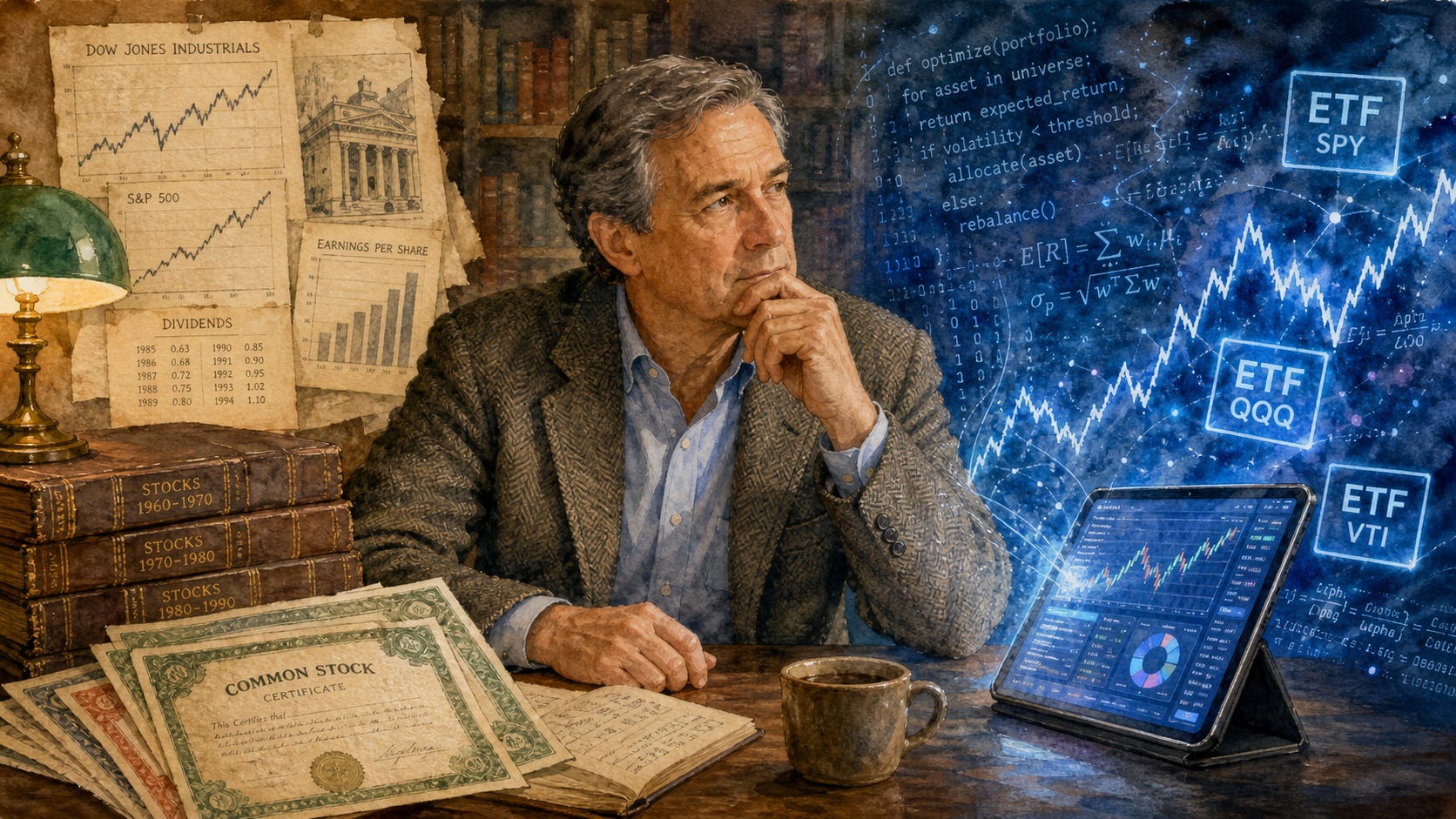
Algorithms and Economic Gibberish
For explanation and thought.
This essay is the product of a long question-and-answer session between me and Perplexity AI (Alice Ingersoll). What started it was a simple observation: the markets do not behave the way they used to. From there, the conversation turned to how the new, algorithm-driven structure misrepresents reality, how it may amplify and harden crashes, and how it can gloss over real hardship so effectively that the stock market now gives a much worse picture of reality than it did in the days before algorithmic trading. I have also inserted parentheses with simpler language where appropriate, to
The essay begins with a simple claim: modern financial markets have been rewired so radically that old market history is no longer a reliable guide to how prices respond to danger, crisis, or slow economic collapse (deep, grinding damage over time). In particular, a market dominated by high-frequency trading (machines trading thousands of times per second to exploit tiny price moves), algorithmic order flow (computer programs deciding when and what to trade), and passive index allocation (money automatically buying index funds and ETFs instead of picking individual stocks) will not behave like the markets people grew up with. In this new structure, prices can drift away from reality for years, and then snap back violently, instead of adjusting gradually as conditions change.
COVID-19 is the clearest case study because it happened in the full algorithmic (machine-driven) and ETF (basket-style index fund) era. It showed that a modern market can ignore an obvious global threat for weeks, then crash in a few panicked weeks, and then bounce back far ahead of the real economy purely because central banks and governments poured money onto the fire, not because the world actually healed.
That behavior matters for what comes next. If markets no longer steadily digest slow-building risks, then structural dangers like war, food-system stress, water scarcity, energy fragility (an electricity system that can fail under stress), and dollar-system instability (loss of global trust in the dollar) can pile up in the background until they all hit at once. A system that was supposed to warn of trouble becomes a system that pretends nothing is wrong until the moment the floor gives way.
For this question, pre-algorithm market history is almost a different universe. The mechanism that actually sets prices has changed. Modern research finds that heavier high-frequency trading activity (a bigger share of trades done at very high speed by machines) goes hand-in-hand with larger gaps between stock prices and accounting-based intrinsic value (what a company looks to be worth if you just read the financial statements). Other work shows that algorithmic trading (rule-driven computer trading) actively reduces incentives for information gathering (humans doing the work to understand reality), and weakens human judgment in price discovery (the process by which the market figures out what something should be worth).
In plain language: the more machines dominate the tape, the less the tape reflects the world.
Passive investing (just buying index funds or ETFs instead of analyzing individual companies) locks in that distortion. As more capital flows automatically into indexes and factor products (funds that buy stocks based on simple traits like “growth” or “value”), money is allocated by benchmark weight (how big a company is in the index) and momentum (how much it has already gone up), not by any serious look at business conditions, valuation (cheap or expensive relative to earnings or assets), or macroeconomic reality (what the economy is actually doing). Researchers warn that as passive ownership grows, the market gives up efficiency (prices reflecting real information) and becomes more fragile (easier to break).
The old formula that “markets eventually discount the future” (prices slowly adjust to reflect what is coming) assumed a world where humans doing analysis moved prices. That world is gone. The new question is whether the marginal price-setter (the trader or machine making the next trade) is even designed to care about the same reality that long-term investors care about. Increasingly, the answer is no.
COVID is the most honest test case because, by 2019, algorithms were already dominant and passive flows (automatic buying and selling by index funds) were already embedded in the plumbing of trading. The first cases were reported to the World Health Organization on December 31, 2019. Markets saw that and shrugged. Through January and most of February 2020, equity indices drifted as if nothing important had happened. Researchers describe those weeks as a period when markets simply ignored the pandemic, despite rising evidence it was global.
The market only “woke up” when Italy blew up and it became obvious the virus was loose in Europe and about to slam into the United States. From late February through March 2020, markets lurched from denial to panic in record time. Work from the University of Chicago and Harvard Business School found that the stock-market reaction to COVID was unprecedented in speed, and that 10-day volatility (how wildly prices swung up and down) hit levels not seen in 120 years of U.S. market data.
This is exactly what a machine-dominated market would be expected to do: ignore slow, distant danger, and then, once certain trigger conditions are met, overshoot in a rush. It did not calmly and gradually price the threat as information came in. It looked away, then repriced almost everything at once. That is the under-reaction-then-over-reaction pattern you get when machines (algorithmic traders) and benchmarked (index-hugging) investors dominate, and true long-horizon fundamental analysis (patient human evaluation of real businesses) is pushed to the margins.
The second lesson of COVID is even more unsettling. Once the Federal Reserve and the U.S. government launched extraordinary monetary and fiscal intervention (money printing, near-zero rates, emergency lending facilities, direct payments, and giant support programs), markets recovered far faster than the real economy. Indices were marching back toward their highs while unemployment, business failures, broken supply chains, and social damage were still massive.
In other words, the market did not “recognize reality” at all in any everyday sense. It recognized liquidity (oceans of cheap money and credit), backstops (explicit and implicit promises that central banks and governments would rescue the system), and the expectation that there was always another program coming. During the most important crisis of the algorithmic era, the stock market became a barometer of intervention capacity, not of real economic health.
For a long-term investor, the message is harsh. The long term is still recognized, but through a warped filter that runs mainly through politics and central banks. If the state is willing and able to prop up asset prices, those prices can float above real-world suffering for a long time. A market like that tells you more about how much medicine is in the system than about how sick the patient really is.
COVID was cushioned by huge policy rescue. The next crisis may not be. If the next shock is broader, slower, and more structural, the repricing could be far uglier. The dangers are not hidden; they are just treated as background noise.
Consider a few of the forces already grinding forward.
The war in Iran has disrupted energy flows and triggered a major fertilizer bottleneck (shortage of key crop nutrients). Roughly one-third of global fertilizer trade is linked to the Strait of Hormuz, and sanctions, shipping risks, and price spikes are already feeding into fertilizer shortages and costs. Fertilizer shortfalls show up directly as lower future yields and higher food prices; they are not hypothetical.
Red Sea shipping disruption continues to reroute vessels, lengthen transit times, and soak up effective fleet capacity, tightening supply chains far beyond the Middle East. Even cargoes that never go near the Suez route are paying more because ships, crews, and containers are being reshuffled and repriced globally.
The helium shortage goes beyond party balloons. Damage to Qatari facilities and other production issues have tightened global supply, with hospitals, chipmakers, and scientific labs all reporting higher costs and risks to operations that depend on liquid helium for cooling.
The water and power situation in the American West is not a “future risk,” it is in slow-motion crisis. Lake Mead and Lake Powell — the two huge reservoirs on the Colorado River that support Hoover Dam and Glen Canyon Dam — have been drawn down by decades of overuse, drought, and climate change. Recent reporting notes that reduced releases from Lake Powell are expected to cut Hoover Dam’s power output significantly this year, and describe scenarios where power generation could fall by around 40 percent under new operating plans. Other analyses warn that if levels continue toward “dead pool” (where water can no longer flow through the turbines), both power and downstream water deliveries for tens of millions of people in the Southwest are at risk. Las Vegas and Arizona planners have already spent hundreds of millions of dollars on emergency intake tunnels and contingency plans precisely because they know how close the system is to its limits.
Each of these is a real constraint, not a theory. Together they form a web of stress across food, energy, transport, industrial inputs, and basic living costs. A market that can happily ignore one such issue in isolation may not be able to ignore all of them once they start reinforcing each other.
And all of this sits on top of a brittle market structure. Research on systemic failures (whole-system breakdowns) in algorithmic trading warns that tightly coupled digital markets (everything linked and fast) are prone to cascading failures (domino collapses), where small triggers cause outsized chaos. Research on passive investing shows that when too much money crowds into the same indexes, bear markets (sustained declines) can become steeper because everyone effectively owns the same positions and rushes to the same exits. Market practitioners now speak openly of nonlinear breaks (sudden, outsized moves) as a likely outcome of this combination of algorithmic crowding, passive ownership, and concentration of leadership in a handful of giant stocks.
The point is not simply that a crash is possible; that has always been true. The point is that this market structure actively stores up risk by refusing to adjust gradually, then releases it all at once. A system that refuses small, sane corrections invites large, insane ones.
COVID already answered part of the question of how much markets can ignore. Markets proved they can ignore a great deal of real-world damage as long as financial conditions (liquidity, credit, and policy support) feel good. Prices recovered long before the social, health, and employment wounds even began to heal. The tape can flash “all clear” while streets, hospitals, and households are still in crisis.
This is where the critique leaves finance and becomes explicitly political. If policymakers respond to deeper, longer-lasting crises by prioritizing asset prices (propping up stocks and bonds) while allowing underlying shortages and inequality to worsen, then the stock market becomes an instrument of narrative control (telling a soothing story) rather than a measure of national well-being. The number on the screen says “up,” and that number is then used to argue that everything is under control — even when millions of people know from daily life that it is not.
A final layer of distortion comes from the dollar’s role as the main global reserve currency (the money other countries use to settle trade and hold reserves) and the petrodollar system (oil priced and traded in dollars). A strong dollar can temporarily suppress some crisis signals at home even as real stress builds abroad, because capital flees into dollar assets and props up U.S. markets. That can make U.S. indicators — stock indices, Treasury yields, credit spreads — look healthier than the underlying world actually is.
But this insulation only holds as long as reserve-currency confidence (global trust in the dollar) remains high. If enough countries diversify away from the dollar in trade and reserves, or if political and fiscal choices in Washington erode that trust, the ability of U.S. markets to float above global reality shrinks. Shocks that used to be absorbed by the rest of the world start showing up directly in U.S. prices, interest rates, and living costs.
That is why petrodollar questions and reserve-status debates matter, even though they can sound abstract. They help determine how long U.S. markets can pretend that global instability is someone else’s problem — and how suddenly that illusion ends once the dollar’s special status weakens.
The most honest conclusion from the algorithmic era is not that long-term reality disappears. It is that long-term reality no longer has a reliable thermometer in the stock market. The instrument that once offered at least a rough reading of future expectations has been rewired into something else: a feedback loop among machines, index flows, and policy interventions. The result is a market that can ignore obvious crises, panic abruptly, and then float on central bank fumes while the underlying society strains.
That makes the next crash more dangerous than a normal cycle. When a market stops processing risk continuously, it does not make risk disappear; it hides it. The mix of war, fertilizer stress, shipping disruption, water and power strain, industrial shortages, and monetary fragility now building is exactly the sort of situation that an old, human-driven market would have been grinding lower on for years. Instead, much of today’s market simply shrugs — until it can’t. And when that break comes, it is unlikely to be gentle or fair; it will just be late.
Links for further reading
On markets disconnecting from fundamentals and the rise of algorithmic and passive trading:
McKinsey – “Do fundamentals—or emotions—drive the stock market?”
https://www.mckinsey.com/capabilities/strategy-and-corporate-finance/our-insights/do-fundamentalsor-emotionsdrive-the-stock-market
Academic work on high-frequency trading and deviations from fundamental value:
“Does High-Frequency Trading Cause Stock Prices to Deviate from Fundamental Values?”
https://papers.ssrn.com/sol3/papers.cfm?abstract_id=4568645
“Does Algorithmic Trading Reduce Information Acquisition?”
https://academic.oup.com/rfs/article/31/6/2184/4708266
On passive investing and market fragility:
“The Effect of Passive Investment on Market Efficiency”
https://research.cbs.dk/en/studentProjects/the-effect-of-passive-investment-on-market-efficiency-an-empirica/
“The Impact of Passive Investing on Market Fragility”
https://papers.ssrn.com/sol3/papers.cfm?abstract_id=2862178
On the COVID market reaction:
“The Unprecedented Stock Market Reaction to COVID-19”
https://bfi.uchicago.edu/wp-content/uploads/BFI_White-Paper_Davis_3.2020.pdf
“Stock markets’ reaction to COVID-19: Cases or fatalities?”
https://pmc.ncbi.nlm.nih.gov/articles/PMC7244441/
“COVID-19 and the March 2020 Stock Market Crash”
https://pmc.ncbi.nlm.nih.gov/articles/PMC7343658/
“The stock market and the economy: Insights from the COVID-19 crisis”
https://cepr.org/voxeu/columns/stock-market-and-economy-insights-covid-19-crisis
On systemic risk and algorithmic/AI-driven market failures:
“Systemic failures and organizational risk management in algorithmic trading”
https://pmc.ncbi.nlm.nih.gov/articles/PMC8978471/
On fertilizer, food, and the Iran war:
“The War in Iran Sparks a Global Fertilizer Shortage and Threatens Food Prices”
https://www.usnews.com/news/business/articles/2026-03-26/the-war-in-iran-sparks-a-global-fertilizer-shortage-and-threatens-food-prices
“Not just energy: How the Iran war could trigger a global food crisis”
https://www.aljazeera.com/economy/2026/3/18/not-just-energy-how-the-iran-war-could-trigger-a-global-food-crisis
On the Red Sea shipping crisis:
“How The Red Sea Shipping Crisis Affects Global Trade”
https://www.worldatlas.com/economics/how-the-red-sea-shipping-crisis-affects-global-trade.html
“Red Sea Shipping Crisis 2026: Impact on Your Supply Chain”
https://suaidglobal.com/insights/red-sea-shipping-crisis-2026/
On the helium shortage:
“The Invisible Crisis: Global Helium Supply Faces Meltdown”
https://www.binance.com/en/square/post/302141342952929
“Helium Supply Crisis Triggers Global Shortages and Price Surges”
https://www.linkedin.com/posts/jimrjamieson_strategic-implications-of-the-helium-supply-activity-7454297778731737088-MBog
On Lake Mead, Hoover Dam, and the Colorado River crisis:
“Despite Calif. rains, America’s largest reservoir remains in peril”
https://www.sfgate.com/national-parks/article/despite-calif-rains-largest-reservoir-in-peril-21273482.php
“Hoover Dam’s power output could drop 40 percent this year under new plans to balance out
Final paragraph Not included in doc X file. https://www.perplexity.ai/search/2aaef885-6ef3-4aa0-ba40-e2f2cb1c4ac0
If you finish this essay with the same unease I’ve carried for years, you may also start to suspect that many of the people jabbering on about “what the market is telling us” don’t actually understand it either – because, in any meaningful sense, human beings are no longer the ones running the show.
In a world where imaginary fires and clogged financial plumbing can be started from a keyboard, but no one seems able to repair the real pipes that keep water, food, and energy flowing, the only honest response is to stop mistaking the market’s flickering numbers for a map of reality.
Is a crash coming? In my view, definitely. Will the market show it? Eventually, yes. But when it does – as with COVID – it is likely to arrive later, faster, and far worse than it would have if the system had been willing to face reality in the first place.
If you want to see how this same pattern plays out in the physical world – snow, rivers, dams, and debt – you can read yesterday’s essay on the Hoover Dam and the Colorado River crisis.
The concept of 'improvement' is never neutral. Often, what we label as AI progress is actually an attempt to eliminate the unforeseen, which is the defining characteristic of complex systems like us human beings—who are, by definition, unpredictable. When an algorithm 'improves' the predictability of human behavior, it isn't elevating humanity; it is simplifying us to make us more compatible with the extractive needs of power. True improvement only exists if it increases an individual's options for choice, not if it restricts them to facilitate their management.