Escaping the Bot Bonanza
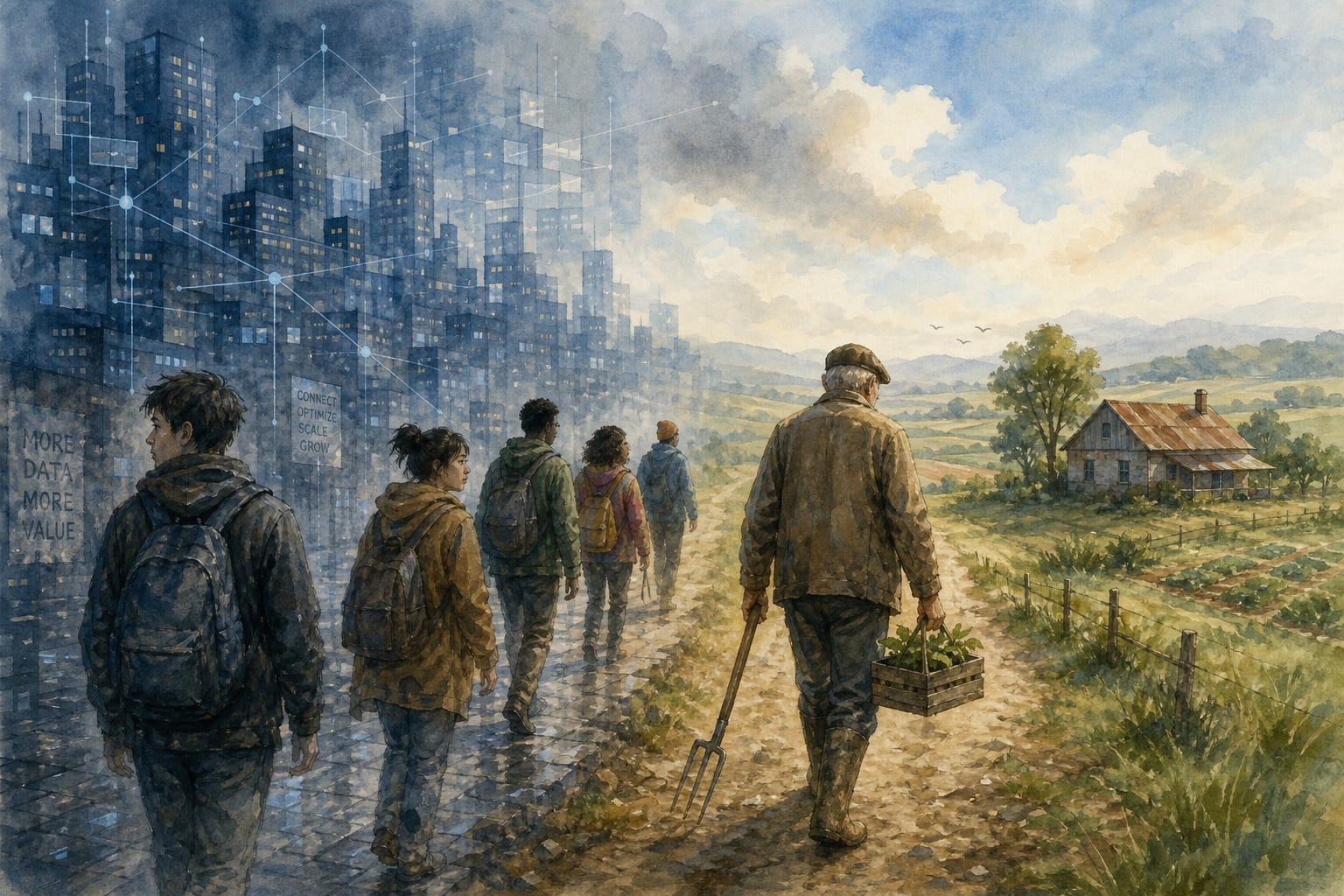
Did the hippies have the answer: It is difficult to monetize your garden without an internet connection, because the bots can’t see it.

Escaping the Bot Bonanza
Did the hippies have the answer?… It is difficult to monetize your garden without an internet connection, because the bots can’t see it.
(This draft has been sitting in my files since July 17th)
If you haven’t been paying attention, you may not realize that while there are nine billion people living on this planet—eating, sleeping, making love, raising children, gardening, breaking down and getting back up again— they have very little to do with what the world is actually doing. Their agency mostly stops at the level of personal life. The systems that decide what happens in finance, politics, justice, media, and even in their own identities are being run by bots, while the language insists that “people” are in charge.
We still talk as if human beings were steering the ship. We say “markets decided,” “voters chose,” “consumers are confident,” “judges weighed the evidence.” But if you look closely at how those systems actually operate, you find the same pattern everywhere: bots make the operative decisions; humans mostly serve as input, ornament, and after‑the‑fact explanation.
Markets and money: the diddling machine
Take the markets first, because they are the most honest about their machinery if you know what to look for.
We still carry around the movie image of a trading floor: a big room full of people with phones and screens, shouting orders, sweating over decisions. That was real once. Today, it is mostly set dressing. The prices you see on your screen are not the product of a thousand men making judgments; they are the emergent output of thousands of algorithms reading ticks, signals, and factor data and diddling prices up or down.
Bots trade with bots. They define “trend,” “risk,” and “value” in terms of their own inputs—moving averages, volatility bands, momentum scores, factor exposures. When those inputs change, they fire orders. Human beings show up upstream as data (earnings releases, macro prints, news headlines) and downstream as storytellers. The actual decision—buy this, sell that, now—lives inside code.
The language refuses to say this. It tells you “Wall Street closed mixed,” as if a crowd of people were weighing options and arriving at a collective mood. It says “investors took profits” when profit‑taking rules fired because a stock tripped a threshold. It says “the market is optimistic” when risk models have moved from “reduce exposure” to “add exposure.” Every phrase smuggles in agency that no longer exists.
Politics and elections: profiles in plastic
We do the same thing in politics. You are told that “voters decided,” that “America rejected X” or “embraced Y,” that “the public sent a message.” The images are familiar: people shuffling into school gyms, tapping ballots, walking out feeling as if they have done their bit. This is the sentimental surface.
Underneath, modern politics is **targeting engines talking to profiles**. Campaigns don’t see you as a whole person; they see a record: age, zip code, purchase history, media habits, inferred religion and race. Bots decide which message you will see, at what time, on which device, delivered by which face. Other bots keep score: polling aggregators, turnout models, demographic simulators. They define what “the electorate” looks like and how “it” behaves.
By the time you arrive at the booth, a machinery of recommendation and persuasion has already done months of quiet work. It has decided which issues feel urgent, which are invisible, which candidates appear serious, which are jokes. When pundits say “voters swung toward X,” they are describing the output of that machine, not an afternoon of sober deliberation in a New England town hall.
You still make a mark on the ballot. But your choice is made inside a field of options the bots constructed and interpreted. The language tells you that you have spoken. In truth, you have mostly **reenacted a logic** that was laid down by code long before you showed up.
Opinion and news: the synthetic public
Then there is “public opinion,” which sounds as if it were the sum of millions of individual voices. In practice, what you encounter as opinion is a pattern produced by filtering and weighting algorithms.
News feeds are not windows onto reality; they are curated strips of content chosen by recommendation engines that have learned what keeps you clicking. Outrage travels because outrage is sticky. Bots notice that and push outrage harder. Soon, whole societies are told “people are furious about X” because machines have amplified a particular emotional pattern. Offline, people may be tired, bored, or quietly indifferent, but the metric says anger, so anger becomes the world.
Polls are machine products as well. Raw responses are scraped, cleaned, and massaged through weighting schemes that define who counts and who doesn’t. Turnout models decide which demographics to emphasize. The headline “Americans support Y” is not a simple count; it is the voice of a synthetic citizen assembled by code out of fragments of data.
You argue, you complain, you post. But you do so inside an agenda laid out by algorithms: which topics are “trending,” which stories are “important,” which opinions are “mainstream,” which are “fringe.” The language tells you “users are saying.” The reality is that **models are deciding** what it even means to be “users” and what “saying” shows up on your radar.
Identity and judgment: scores instead of faces
Once, your reputation was something people discussed. Neighbors, bosses, clients, and cousins passed stories; you were judged by those narratives. Now your reputation is largely **a score**.
Credit scoring software decides whether you can have a mortgage or a car. Risk models decide whether you are safe enough for a job or an apartment. In some jurisdictions, crime‑risk tools help decide whether you wait for trial at home or in a cell. These are not human judgments in the old sense. They are calculations run on data: a missed bill, a move, a job change, a fine.
The system generates a number. That number travels with you. Bankers, landlords, employers, and judges see the number and treat it as your distilled worthiness. They may adjust at the margins, but most of the time they do not rewrite the score; they defer to it.
The language says, “We evaluated your application,” “the judge weighed the circumstances.” In daily practice, the bot sorted you into a bin and human beings hesitated to disagree. You remain a person in your own mind, but a growing part of the world sees you as a vector of risk and return.
Goods, services, and an economy without us
Now push the logic to its limit.
Imagine the bots keep doing exactly what they do now—trading, optimizing, routing, scoring—but we drop the polite fiction that human behavior is what drives the system. What happens?
The bots can:
- Continue trading stocks, bonds, currencies, and derivatives.
- Continue allocating capital to factories based on expected returns.
- Continue generating “demand” signals from models and sending purchase orders to firms.
- Continue routing containers and scheduling trucks along supply chains.
Factories will keep producing televisions, refrigerators, routers, shoes, and toys. Warehouses will keep filling. Logistics software will keep moving pallets around in a dance of supply and forecasted demand. Each step in the chain will be recorded as “output,” “trade,” “inventory,” “GDP.”
Now imagine… If… Nobody ever opens the boxes. No child ever plays with the toys. No family ever eats the food. The goods sit, shrink‑wrapped, under automated lights in automated buildings. From the bots’ perspective, the economy is humming. Orders placed, goods delivered, payments cleared. Whether any living creature uses what the system produces is not a variable in the model.
Services complicate the picture—haircuts, surgeries, nursing, teaching. Machines cannot yet wash a patient, cut hair with taste, or comfort the dying. But even here, much of the surrounding logic is already algorithmic: triage scores, billing codes, insurance approvals, scheduling. Human contact happens inside decision frames built by software.
In this imagined world, humans are **biological endpoints** the system occasionally has to account for: calories, beds, cells. The main engine of coordination and allocation is fully machinic. The bots buy the goods, ship the goods, store the goods, and mark the ledger as “healthy.”
The unnecessary city
Once you see that, cities begin to look less like centers of human life and more like centers of machine life.
The city used to be where agency gathered: craftsmen, printers, doctors, traders, teachers, editors, politicians, all doing work that mattered directly. Now, in many cities, the central functions are data centers, banks without tellers, logistics hubs, and office towers full of people whose job is to feed and interpret machines.
In that environment, a harsh observation becomes hard to avoid:
If you’re in the city, you are increasingly unnecessary to the system. You are there to fill up the roads with traffic, the sewers with waste, and the spreadsheets with data. The bots do the work the system actually cares about.
The system needs bodies to sell to, score, and occasionally punish.
It does not need your judgment.
It does not need your presence, except as a source of data.
The more your city life consists of staring into screens, filling out forms, and obeying automated instructions, the more obvious it becomes that you are a peripheral device attached to a machine you did not design.
We have seen one instinctive reaction to this before.
In the late 1960s and 1970s, some of the Woodstock generation tried to walk away. They moved to communes and back‑to‑the‑land homesteads, determined to grow their own food, feel real sunshine on their backs, and build lives that answered to soil and weather instead of schedules and fluorescent lights. Most of them, in the end, sold out or drifted back. The city and the economy pulled them in. The machine was patient; it had salaries, supermarkets, and warm apartments to offer.
But what was half‑formed then is clearer now. Those hippies were not just chasing a pastoral fantasy; they were groping toward an escape from a system on its way to becoming fully machinic. Today, that system has grown into the bots that run markets, score citizens, shape opinion, and route goods. They didn’t have language for that; we do.
The only life the bots can’t live
Once you concede that the core systems—finance, politics, media, identity, the shell of the economy—have quietly written human agency out of their scripts, the choices narrow.
You can stay in the city, fully wired into the bots’ logic, and accept your role as data and waste. You can continue to let your worth be measured in scores, your views shaped by feeds, your “choices” massaged by campaigns, your future discounted by models. You will remain busy—meetings, deadlines, subscriptions—but you will be busy inside a system that does not need you to exist as a person, only as a signal.
Or you can begin to do what the Woodstock generation never quite finished: move your life into spaces and practices the bots are bad at.
You can grow your own food. Kill your own meat. Build and repair your own shelter. Live among neighbors you can see and touch, in a place where the primary systems you deal with are weather, soil, wood, and animals, not dashboards and scores. You will not escape the machine entirely—it will still send you tax notices and insurance bills—but you will no longer be one of its moving parts. You will be a human being in a particular place, doing work that exists for reasons other than data.
It is difficult to monetize your garden without an internet connection, because the bots can’t see it. That may be the clearest proof that you’re finally doing something for yourself. If the bots can’t measure you, you might become real again.
