Robber Baron Pools Meet Al Gorithm
We are more bamboozled today than Americans were in Twain's Gilded Age

Robber Baron Pools Meet Al Gorithm
We are more bamboozled today than Americans were in Twain’s Gilded Age
When I was in college, I read Matthew Josephson’s The Robber Barons for the first time. (1970) I found it fascinating and enlightening. I have read it a few times since. It’s a necessary book, not just for the portraits of men like Gould and Vanderbilt, but for the way it lays bare the mechanics of “respectable” theft in markets that nobody seriously mistook for fair.
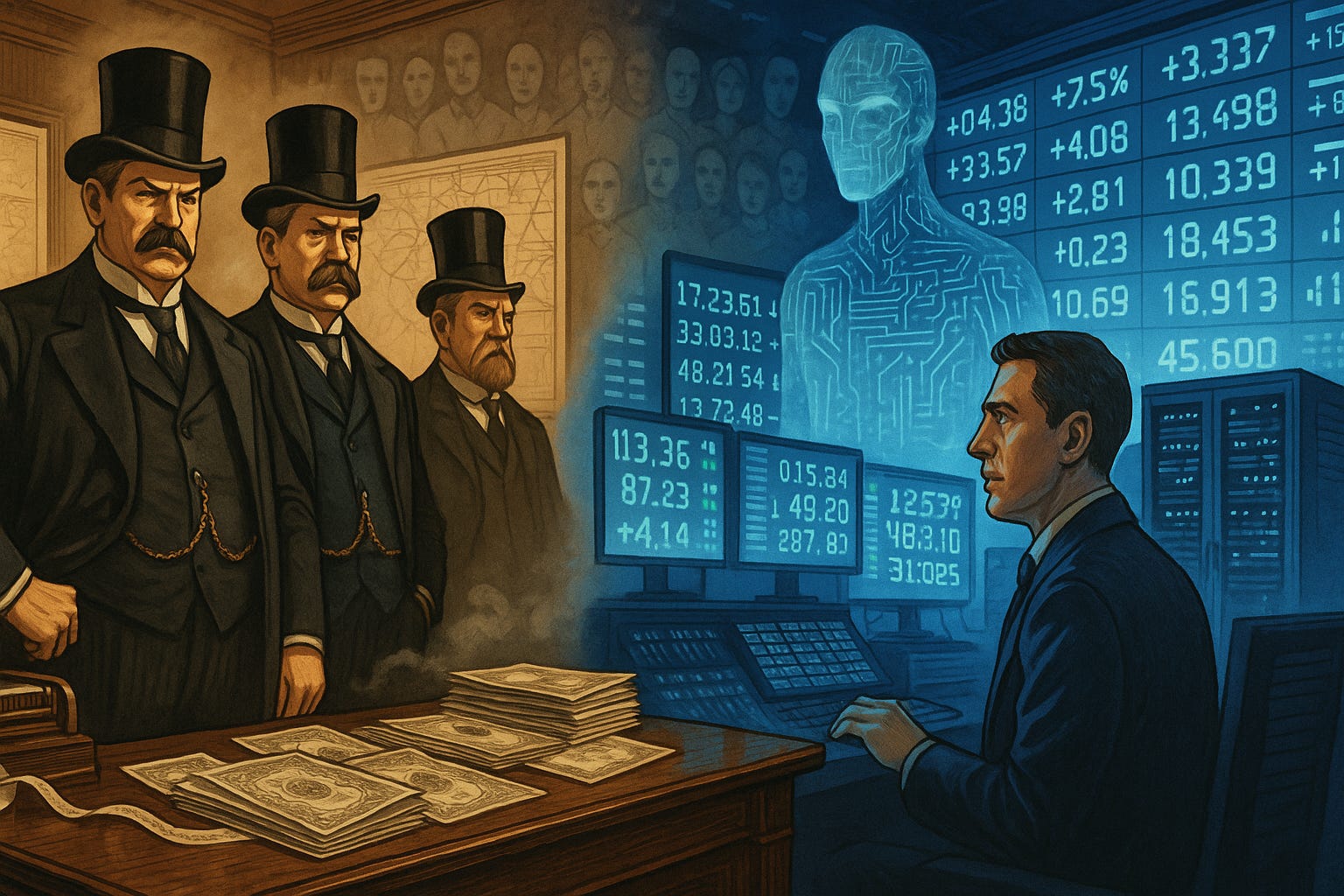
In some ways, those earlier investors were less deluded than we are today: they knew they were stepping into a rigged game, while we have let a century of propaganda, “financial education,” and technological glitz convince us that the same basic exploitation is fairness and progress. Presiding over today’s version of that rigged game is a new, unseen operator I’ll call Al Gorithm.
In some ways, those earlier investors were less deluded than we are today: they knew they were stepping into a rigged game, while we have let a century of propaganda, “financial education,” and technological glitz convince us that the same basic exploitation is fairness and progress. Presiding over today’s version of that rigged game is a new, unseen operator I’ll call Al Gorithm.
From Railroads to Robots: How Old Market Scams Came Back Wearing the Mask of “Technology”
In the 19th century, nobody pretended the great railroad barons were saints. Jay Gould, Cornelius Vanderbilt, and their peers built empires by gaming a system they helped design. Gould boasted that he could hire half the working class to shoot the other half; he also quietly bought judges, legislators, and newspapers while running classic stock manipulations—watering shares, issuing new securities against dubious assets, and staging battles for control that were as much theatre as business. Vanderbilt, lionized as a genius, perfected the art of squeezing rivals and minority shareholders through rate wars, secret rebates, and complex holding structures that left ordinary investors permanently behind the information curve.
Much of this trickery centered on the railroads’ stocks and bonds. Powerful insiders controlled the flow of news, the timing of dividends, and even the physical books in which ownership was recorded. They issued new shares to themselves at privileged prices, used corporate treasuries to support their own positions, and leaked or invented rumors to move markets in their favor. The line between “enterprise” and “scam” was thin. People understood that a man like Gould was playing a rigged game; they also understood that the law, such as it was, mostly served his class. It took spectacular panics, political outrage, and a long series of scandals to begin putting even partial limits on this behavior.
By the 1920s, the same spirit had migrated from rails to the broader stock market. The instruments were new, but the logic was familiar: a small club of well‑connected players used their superior position to manufacture prices and then dump the bill on the public. These were the days of the “pools”—formal or informal syndicates formed to manipulate the shares of a chosen company.
A typical pool in that era was simple in structure and ruthless in effect. First, the insiders quietly accumulated a large position in a stock, often with the help of a friendly exchange specialist who saw everyone’s orders. Next, they traded among themselves at rising prices and volumes, creating the illusion of powerful demand. Market columns and tip sheets—sometimes secretly on the pool’s payroll—would praise the stock’s “strength” and hint at bright prospects ahead. Ordinary investors, seeing the tape and reading the commentary, rushed in. Once enough public money was committed, the pool sold into that frenzy, locking in gains while the last buyers were left with inflated shares that soon fell back to earth. RCA’s pre‑crash surge, propelled by relentless promotion and insider dealing, became the emblem of the period.
After the 1929 collapse, congressional investigations finally dragged these practices into the light. Hearings revealed banks running pools in their own securities, brokers trading against their clients, and a general pattern of “market management” that looked far more like organized deception than anything resembling fair price discovery. The response was the Securities Exchange Act of 1934 and the creation of the SEC, which explicitly targeted “manipulative or deceptive devices.” Congress outlawed wash sales, matched orders, and other classic tricks that created fake volume and fake prices. For a time, the message seemed clear: using insider coordination and phony activity to push prices around was not “smart business,” it was illegal.
But rent seeking—using position and cleverness to extract unearned gains—is a hardy weed. It flourishes wherever information is uneven and rules are weak. As markets moved from paper tickets and hand‑written ledgers to electronic screens, the technology changed. The basic impulse did not. What used to be organized in smoke‑filled rooms is now written into code and housed in server racks, but the goal is still to turn markets into machines that reward those who can move faster and see more than everyone else.
Today, this shows up in the form of algorithmic and high‑frequency trading. The jargon is new, but the game often looks suspiciously like the pools in digital dress. Modern “spoofing” algorithms, for example, place large orders they never intend to execute, solely to create the illusion of demand or supply and nudge prices in a favorable direction. Once other traders react to the fake orders, the algorithm cancels them in milliseconds and trades the other side. “Layering” spreads these bogus orders across multiple price levels to exaggerate depth, steering perceptions of where real buying and selling lies.
Regulators have had to admit that these practices are manipulative enough to violate existing law. Spoofing was specifically banned in U.S. futures markets after the 2010 “Flash Crash,” and large institutions have paid heavy fines for using it in metals and bond markets. Yet enforcement is always looking in the rear‑view mirror. High‑speed firms can submit and cancel thousands of orders in the blink of an eye, making it extremely difficult to distinguish between “aggressive liquidity provision” and outright fakery in real time. Meanwhile, other algorithmic tactics skirt the edges of the law—pinging dark pools for hidden orders, racing ahead of slower participants to capture risk‑free profits, or flooding the market with quotes that momentarily overwhelm competitors’ systems.
To the average investor, this is mostly invisible. What they see are flickering quotes and charts that sometimes behave in ways no human story can really explain: sudden collapses and spikes that vanish in seconds; prices that go haywire and then instantly “correct”; patterns where entire sectors move in lockstep on no news at all. The official story is that this is “liquidity” and “efficiency,” the inevitable by‑product of progress. But many institutional traders now quietly concede that these same systems have made markets more fragile and more easily gamed, not less.
The deeper problem is cultural and political, not just technical. Once again, practices that would have looked like obvious manipulation to earlier generations are being normalized because they are wrapped in new language and new machines. Where a 1920s pool operator needed a willing newspaper and a cooperative specialist, a modern operator needs a co‑located server and a clever programmer. Where the old robber barons bought influence in legislatures, today’s financial and tech interests help write the rules of the digital markets they dominate. The effect is the same: a small, well‑positioned minority skims off value by shaping the game itself, while everyone else is told that this is the price of modernity.
We call this “technology.” We call it “innovation.” We are told it is necessary for “progress.” But in its economic substance, much of our current market machinery looks less like a neutral tool and more like the re‑legalization of behavior that earlier generations, fresh from disaster, were willing to name plainly as manipulation and crime. The stock pools did not really die; they were reborn as algorithms.
The lesson, if we are willing to draw it, is not that markets naturally become fair over time. It is almost the opposite. Left to themselves, complex financial systems drift back toward arrangements in which those nearest the switches and screens extract the most, and call it genius. What changes, mainly, are the costumes and the justifications. The railroads had their “captains of industry.” The 1920s had their “pools” and “market support.” Our age has its “high‑frequency liquidity providers” and “smart order routers.”
Behind the jargon, the current phraseology and the weasel words, the old pattern remains: Dishonesty and rent seeking flourish wherever they can, until catastrophe or public anger forces a temporary clampdown. To see that clearly is not cynicism. It is simply refusing to let new labels hide old crimes... old crimes that are now legally recognized new ones.
And so it goes at the end of empire.
Sources / Further Reading
The Robber Barons. https://a.co/d/eA6FkM2
Market manipulation and 1920s stock pools:
https://papers.ssrn.com/sol3/papers.cfm?abstract_id=596606
https://archive.nyu.edu/handle/2451/26529
https://www.sciencedirect.com/science/article/abs/pii/S0304405X98000579
1929 crash, pools, and promotion culture:
https://wiserinvestor.com/the-stock-market-crash-of-1929/
https://novelinvestor.com/a-short-tale-of-a-stock-promoter/
Securities Exchange Act of 1934 / anti‑manipulation rules:
https://www.investopedia.com/terms/s/seact1934.asp
https://uscode.house.gov/view.xhtml?path=/prelim@title15/chapter2B&edition=prelim
https://www.govinfo.gov/content/pkg/COMPS-1885/pdf/COMPS-1885.pdf
Modern algorithmic manipulation (spoofing, layering, etc.):
https://discoveryalert.com.au/automated-trading-dark-side-2025-manipulation/
I had a subversive eighth grade English teacher [probably a closet socialist] who used the muckraker literature of the gilded age to introduce her students to the gross excesses of unregulated vulture capitalism. I can't imagine any public school teacher getting away with using such a curriculum today, especially NOT with impressionable coming-of-age students who might correctly conclude that capitalism is an inherently evil system!
They were describing the same sort of sweat shop workplace conditions that corporate-serving quisling political hacks are always trying to bring back. The "good old days" championed by the likes of Dear Leader Trump and cohorts, don't ya know!
What concerns me most right now is that the ruling vulture class is now launching a massive currency devaluation campaign that will wipe out western middle class savers everywhere.
The FED is signalling that a great financial reset is about to launch, because the US dollar is too strong for the US to compete in global markets and the debt death spiral must be addressed to retain financial solvency of the FED and the US 'gummit'.
There are only three options available:
1. Massive cutbacks and austerity that no politician will ever vote for because it would just be too painful
2. Hard default, again an impossible option
3. Soft default through currency devaluation, the option they historically have always gone for.
It is implemented in several steps involving massive, coordinated selling off of US dollars to force value down, acting in concert with other central banks [specifically including the EU and Japan who also need the same result[. The objective is a 30% to 50% dollar devaluation, after which it will take twice as many dollars to buy the same goods.
It is all outlined and explained in summary form here:
https://m.youtube.com/watch?v=tdSA9YL_JCU