Same Old, Same Old
A New Golf Course for Nasty Land

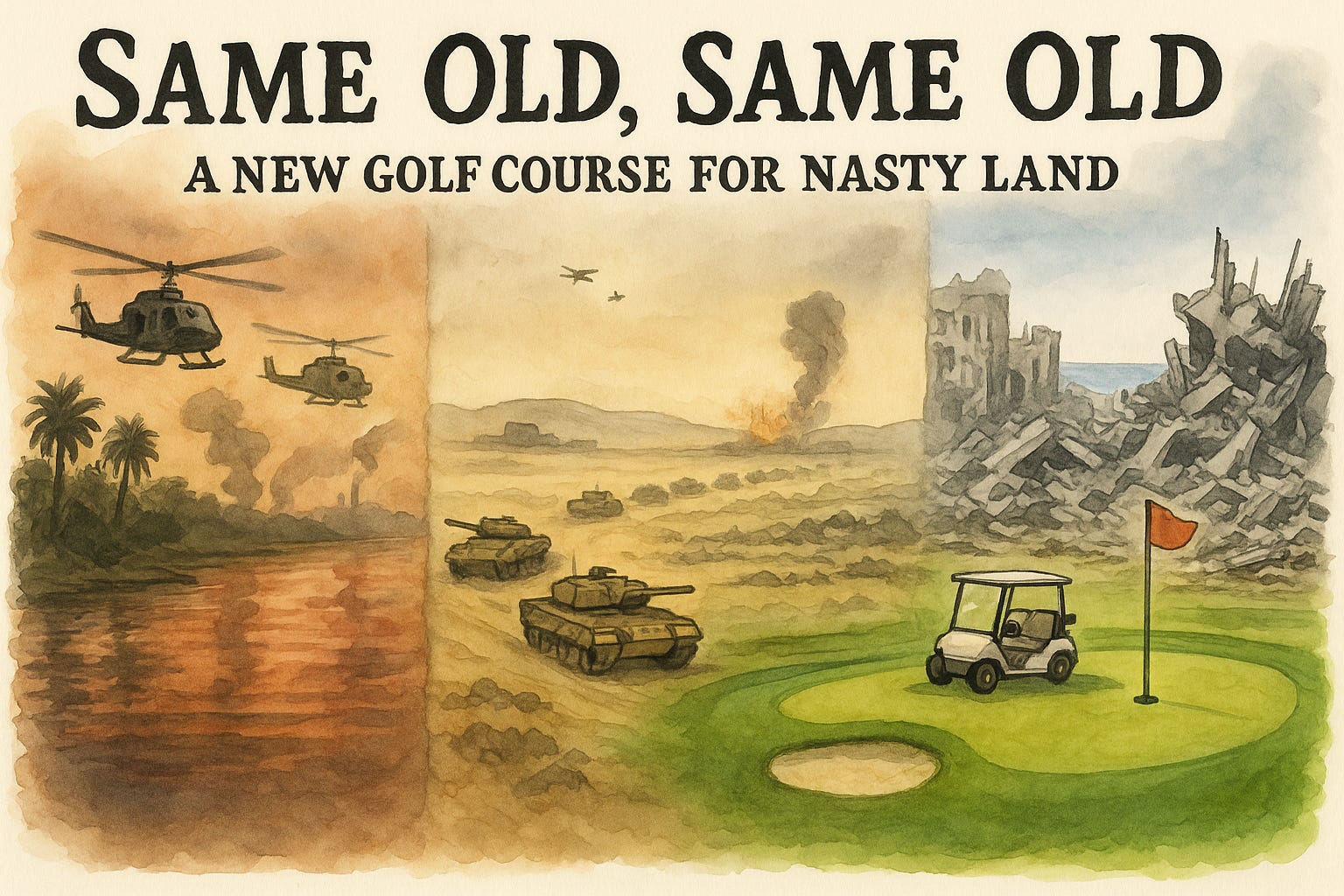
Same Old, Same Old
A New Golf Course for Nasty Land
I was twenty years old when I understood in my bones, that America was a nightmare.
I had sensed the land was rotten when Kennedy was shot. But by 1964 I was putting stickers of LBJ on cars in Arborland, Ann Arbor.
The great society was shouting… Civil rights Hurrah.
Then in 1968 I watched John Kennedy’s brother Bobby assassinated on live Black and White TV. Soon after that I graduated from high School. Then I burned my draft card.
The signals had been shouting, growing up in Ann Arbor Michigan- surfacing in 1966, and then in 1967 participating in South university protests as Sheriff Harvey of Washtenaw County, Michigan tear gassed the protesters including the seventeen-year-old me.
Vietnam.
Jungle on the TV every night, napalm blossoms, body counts delivered like weather reports. I was out in the streets, doing what passed for protest, sometimes revisiting the tear gas, already sure this country was capable of horror, already certain the myths were lies. I knew we were the bad actor in the story. I knew the rhetoric about freedom was cover for something much uglier.
Marching, marching on Washington three times.
After college I walked away, no law school, no grad school… I dropped out and moved to my magicland place, Aspen Colorado… amazing then… Long gone now, except for its beauty which man cannot destroy… The mountains are too grand.
But even then… Even with Vietnam disgust, I still had a floor in my mind. There were things I thought we would not do. Lines we wouldn’t cross. It turns out I was wrong.
Because the bombs never stopped. The wars never stopped. They just changed their clothes.
After Vietnam it was other jungles, other deserts, other cities with names we mispronounced. The footage lost its color and its blood and became “surgical strikes,” night‑vision blobs on a screen, precision explosions narrated by men in suits. Iraq, Afghanistan, the endless “operations” and “interventions.” Drones that killed from half a world away, pilots sitting in air‑conditioned trailers before driving home to the suburbs after a day at the office.
The killing got cleaner on TV. The language got smoother. There was no more draft. The public got used to it.
You could spend an entire adult life in this country with a permanent low hum of war in the background and never have to feel it on your skin. It became part of the weather. Something other people endured while you changed channels.
And then Gaza happened.
Not as a sudden revelation, but as the logical endpoint of everything that came before it. An entire strip of land, a long, narrow beach, pounded into rubble in full view of the world. Apartment blocks collapsing in real time. Hospitals, schools, bakeries erased. Families living and dying in a density you could barely comprehend, trapped in a cage they never chose, and then having the cage hammered into dust.
People watched it. That’s the disgusting part. They watched it.
They scrolled past it on their phones, muted it on their TVs, skimmed the headlines: “retaliation,” “security,” “complex situation.” They watched the before and after satellite photos like they were looking at a weather map: here’s the storm system rolling in, here’s the clear sky afterwards. They watched, but they didn’t see.
Because if you actually saw it, if it got past the words and the framing and the “both sides” and lodged where it belongs, you would have to admit what it is: a beachfront cleared by explosives. A future development site carved out of human bone.
Tell the twenty‑year‑old version of me that someday America would be more or less fine with flattening an entire coastal strip—that we would watch mile after mile of seaside city ground down and, instead of recoiling, start talking about “reconstruction,” “investment,” “opportunities.” Tell him that we would look at a long Mediterranean shoreline turned to dust and quietly, somewhere in the back of our minds, see golf courses and condos.
I would not have believed you. Not because I thought this country was decent, but because I couldn’t quite picture that level of open, casual evil being normalized.
But here we are.
We live in a time when developers can look at ruins and see “potential.” When politicians can stand in front of smashed concrete and talk about “the future.” When the idea of turning someone else’s graveyard into your resort isn’t treated as a crime, it’s a business plan.
You want to know what happens to a nation that spends fifty years turning everything into product? That takes feeling and turns it into talk shows, turns thought into content, turns friendship into networking, turns privacy into data, turns politics into branding? Eventually it looks at a strip of land piled with bodies and sees prime real estate waiting to be monetized.
You could feel the shift in the language around Gaza if you were paying attention. At first, people still pretended to argue about causes and blame. They performed concern. They said the words “humanitarian crisis” with the right furrowed brow. Then, slowly, the talk moved to “what comes next.” Governance. Security arrangements. Infrastructure. Foreign investment.
Nobody wants to say out loud what that really means: who gets to build the hotels. Who gets the contracts. Who gets the view of the sea over the wreckage.
It’s the same sickness, just in its final, terminal form. The same instinct that tells you to monetize your newsletter and your grief and your children’s attention is the one that looks at bombed‑out coastlines and imagines future amenities. If everything is a market, then war is just another kind of clearance sale. You remove the unwanted inventory—wrong people, wrong history—and free up space for a better class of customer.
When I was twenty, standing in crowds and chanting against the war, I thought we might learn something from Vietnam. That the sights burned into us then—villages on fire, children running from napalm—might inoculate us against doing anything like that again. I thought the horror might stick.
It didn’t. It just went into syndication.
The bombs kept falling. The screens got better. The commentary got slicker. And the audience learned the one lesson that the people in charge needed them to learn: this is normal. This is complicated. This is unfortunate but necessary. This is something happening “over there.”
Gaza is not over there. Gaza is the mirror.
It shows you exactly what this culture has become: a place where you can livestream an extermination on a beautiful stretch of coast and still sleep at night because the right kinds of people assure you it’s about security and democracy. A place where the possibility of future resorts on that same coastline doesn’t disgust everyone instantly. A place where flattening a long beach so you can build new toys on top of the rubble is not unthinkable; it is merely a matter of time and politics.
The question that hangs there, if you let yourself see it, is simple and not simple at all: if even the twenty‑year‑old version of you, already knowing America was capable of terrible things, could not imagine we would be this blatant, this public, this numb—what exactly happened in between?
The answer is not a mystery. We trained ourselves not to see. We trained ourselves to treat other people’s lives as content. We trained ourselves to translate everything into opportunity, including ruins. We got very good at watching without feeling, at consuming without caring, at hearing the word “flattened” and thinking first about construction, not about bodies.
That’s what fifty years of this does to a country.
If there’s anything left worth saving, it starts with letting the word Gaza mean what it actually is: not a “conflict zone,” not a “security challenge,” not a “complex issue,” but a strip of earth where human beings were crushed so that someone else’s future plans could go ahead unbothered.
If that doesn’t revolt you, if that doesn’t make the younger version of yourself stare back at you in disbelief, then the bombs have already done their real work, and not just over there.
Here is a link to a different plan, a better system, an old and new idea… fairness and equality… Phoenix America
Look at what is being done to the flotillas and their people.
Bring in the diesel trucks. Shut it down.
Translation from french by PONS
Hello, another way to consider current events, geopolitics, and history.
Zionism (virus, climate scam, ...) is created by the English-speaking world.
Fraudulent use of the Bible: the "Israelites" are only our thoughts that follow the law ("Moses") in the desert of the mental consciousness (or existential solitude) and that must invest the inner Kingdom ("Jericho"); the ramparts are our preconceived ideas, beliefs, dogmas, ... .
Myths and Science (Jung's synchronicities, modern physics, Victor Hugo's "divine fabric", ...) The USA is the Georgia Guidestones, the return of the Yeti beast named Bigfoot, the Mictlan (north and hell) of the Aztecs, the temple of Mammon in NY, ...: https://www.youtube.com/watch?v=m9rzgllkiC0&list=PLYHHkNZz74gu9F5eJ5Pls7rDyMFQhYtiV (Odyssey, Rumble, Crowdbunker, etc.).
In France, Macron - the Zionist (and other) follower - is Emmanuel/Zeus at the Elysée, of course (and not Jesus); an Oedipus (inner demon) who kills the Father (Fatherland) and marries his mother (intellectual, his teacher); a "Brigitte," the name of the Gaulish goddess (therefore old Psyche), etc. (even if cross-dressing or transsexual, which adds to the complexity of the character). Etc.
Ulysses (you, me) must find his inner life (Ithaca), his faithful Psyche, and the only Son (Christianity) with the help of which our pretending demons are destroyed; his animality is dead (the dog); etc.Right now, many Christs in Palestine!