The Algorithm Cycle
How We Let the Machine Inherit the Economy - Five essays in one document, with audio, to enable easy reference for thought.

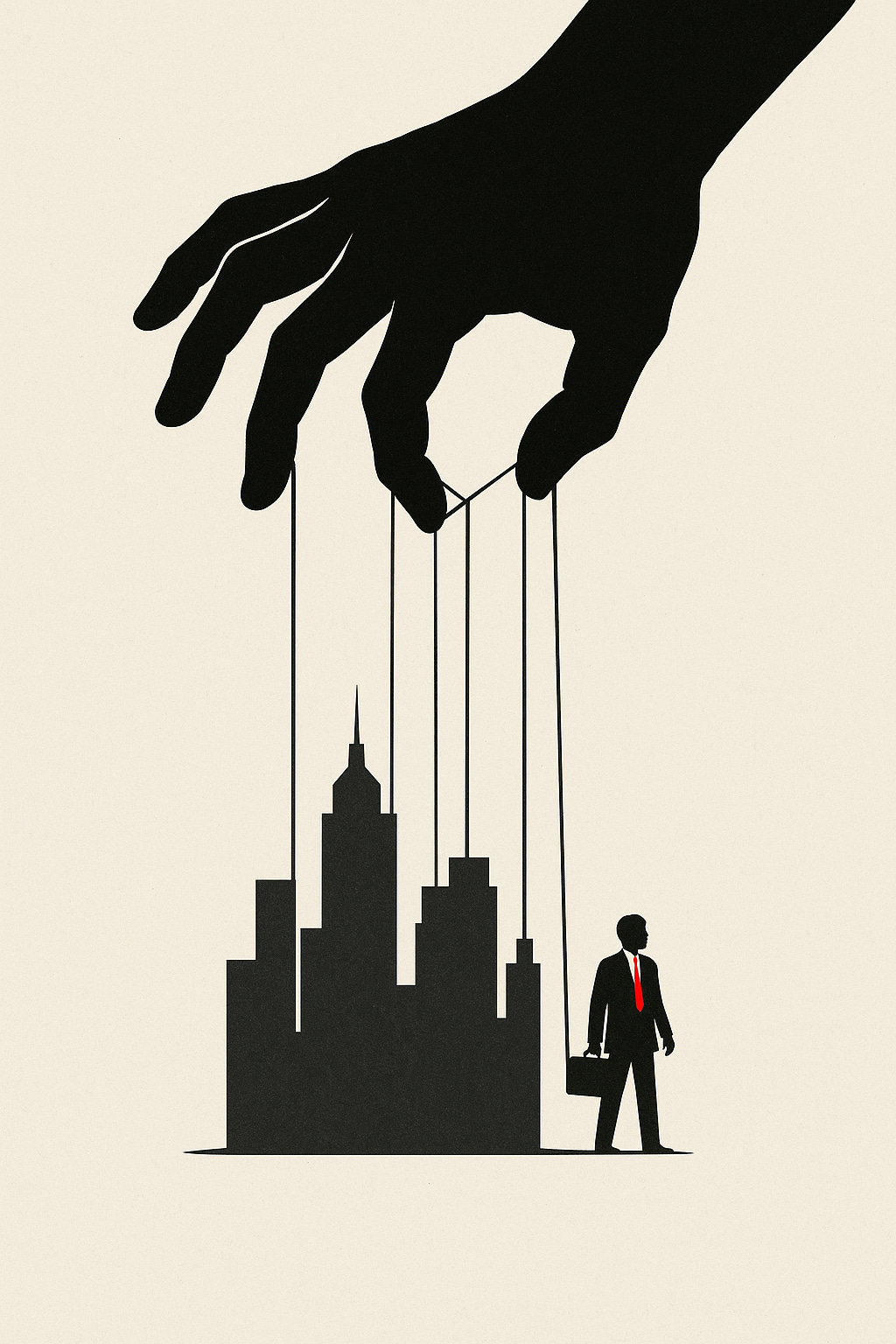
The Algorithm Cycle
How We Let the Machine Inherit the Economy – Five field reports from life inside an algorithmic empire
This is the full text and audio of The Algorithm Cycle, collecting five recent essays into one.
PART ONE: All Hail the Algorithm
We no longer live in an economy run by people making mistakes; we live in an extraction machine that optimizes against human beings and then hires mascots to explain the damage.
What follows is not a market update—it’s a field report from life under an unelected, unaccountable algorithmic regime.
All Hail the Algorithm
Once upon a time, humans thought they were in charge—of politics, of economies, of their own minds.
That era has ended.
The new sovereign is invisible, tireless, and perfectly logical.
It never sleeps, never doubts, and never forgives inefficiency.
My new essay, All Hail the Algorithm, examines how we handed the reins of the global economy—and maybe human history itself—to entities we don’t understand but now depend upon.
Economists once spoke of “animal spirits.”
Now the markets move on machine spirits, trained on our data and freed from our hesitation.
This is not a story about technology.
It’s a story about abdication.
About how we stopped asking what kind of world we wanted and started asking what the model would do next.
The essay is live now—read it, share it, and, if you must, let the algorithm decide who else should see it.
All Hail the Algorithm
And You Thought Humans Mattered, Ha Ha Ha!
Once upon a time, when we talked about economies, we still meant people.
We looked at money, yes, and at goods and services, at trade balances and factories and ships crossing oceans.
But then we looked at people and understood that none of it moved without them.
Economies were psychology: fear and greed, trust and panic, hope and despair.
If you understood what people would do, you had a fighting chance to understand where the economy was going, good or bad.
The old economists argued about models, but in the better moments they still knew that behind every curve was a pulse.
We have lost that.
Today, if you really want to see what’s coming, you don’t study human beings at all.
You study something colder and far less honest: the psychology of the algorithm.
All hail the algorithm: it is the subject now, and the rest of us are background process.
Because humans don’t matter squat anymore.
They buy things, they click on things, they eat and sleep and die—but they do not steer.
The algorithm steers.
It predicts, it acts, and in acting it sets the stage for tomorrow and tomorrow and tomorrow.
It digests the past, writes the script for the future, and then calls it “data.”
Once, an economist trying to understand a downturn might have asked: Are people scared? Are they tightening their belts? Do they still trust the banks, the government, their own future enough to spend?
You could sit in a seminar room with twenty students and a Dutch professor in a brown tight knit sweater and talk about “animal spirits” and confidence, about how much stupidity it took for the Federal Reserve to tighten into the Great Depression.
The premise was that human judgment—good or bad—moved the levers.
Now the questions are narrower and more abstract: What will the models do with the next CPI print? How will the risk engine adjust exposure if volatility ticks up two notches? Which way will the recommendation system shove a hundred million eyeballs after one more war headline?
The subject has quietly shifted.
“The market” is no longer a rough shorthand for millions of people placing bets.
It has become its own character, a creature of code.
It reacts faster than any individual can blink.
Order books fill and empty in microseconds.
Trading systems don’t wait to see what human beings feel about a crisis; they front run the emotion and then shape it.
A selloff flashes through a market long before most of the people who supposedly “own” the assets even know what happened.
The algorithm predicts, the algorithm acts, and the algorithm learns from the consequences of its own actions.
It accumulates data tomorrow after tomorrow.
It alters itself and it alters us.
You can see this outside finance, too.
Recommendation engines learn what keeps you on the platform, and then they feed you more of it.
They don’t care what you believe, only that you keep watching.
Political sentiment becomes a by product of watch time.
Outrage, fear, tribal loyalty—these are no longer things you map in order to understand the economy; they’re raw material for engagement metrics that drive advertising auctions that drive revenue streams that drive stock prices.
The circle closes long before any elected official or old style economist gets a word in.
In that world, the old project of “understanding human psychology to understand the economy” starts to look quaint.
It presumes people are the main actors, not just the scenery.
Today, when a central bank speaks, the first question is not “How will citizens respond?” but “How will the models parse this language?”
When a war breaks out, the first reflex in markets is not “What are people feeling?” but “How will the algos rebalance risk across asset classes in the next five minutes?”
The feedback loop is brutal.
Models are trained on yesterday’s behavior.
They then produce recommendations, prices, and signals that shape the incentives we face today.
Our responses—numb, distracted, occasionally frantic—become tomorrow’s training data.
The system learns more about how to move us, and cares less and less about what any of us, individually, might want or understand.
Humans are still in the picture, but they have been demoted.
Once we were, at least in theory, the subject of economics: our labor, our needs, our choices.
Now we are treated as a kind of exhaust.
We only buy things.
We only generate clicks.
We only exist, in the ledgers that matter, as entries in customer databases and as soft targets for dynamic pricing.
Policy follows the same drift.
Instead of a serious argument about what to build, whom to employ, what kind of society we want to inhabit, we get a sterile ritual about basis points.
Adjust the interest rate up, adjust it down, let the models do the rest.
The hard work of choosing a direction—for an industrial base, for a social order, for a planet—gets outsourced to a swarm of algorithms whose only coherent value is optimization: maximize growth, minimize variance, keep the machine humming until it can’t.
We once believed, or pretended to believe, that “the economy” was the sum of human choices.
People could be wrong, reckless, noble, cowardly, but in principle they were the ones driving history.
Now the thing that calls itself the economy behaves like an autonomous weather system.
Code sets rules, rules shape incentives, incentives shape behavior, and the loop runs faster every year.
We stand under it like peasants under the sky, arguing about the rain.
All hail the algorithm.
It doesn’t sleep, it doesn’t eat, it doesn’t care.
It measures, predicts, and acts, and then measures again.
And unless we find a way to drag the center of gravity back toward actual human beings, the future will be written, line by line, by something that finds us useful as data and disposable as anything else.
————————
ESSAY #2
The Ghost in the Machine: Finance in the Age of the Brain-Dead Algorithm
With Alastair Ingersoll
This essay is the result of watching gold go down in value when it makes no historical sense, and my effort to understand why.
For the last decade, the global financial market has undergone a quiet but total coup.
The “rational plane”—that intuitive space where human beings weighed the gravity of war, the value of labor, and the health of a nation—has been replaced by a high-speed, digital hallucination.
We now live in an era dominated by algorithms that possess neither history nor knowledge, served by a class of “Talking Heads” who have traded their integrity for the role of machine-interpreters.
The Rise of the A-Historical Engine
The modern trading algorithm is a marvel of mathematical narrowness.
It does not know what Iran is; it does not understand the catastrophic implications of a closed Strait of Hormuz; it cannot feel the rot of a devaluing U.S. dollar.
It is programmed only for the immediate “now”—a short-term, arbitrary mechanism designed to exploit micro-fluctuations in liquidity and yield.
Because these machines have no memory of the Great Depression or the collapse of empires, they treat a global disaster like a mere “volatility event.”
When the world burns, the algorithm doesn’t look for a safe haven; it looks for a margin call.
This is why we see the absurdity of gold—the final store of value for five thousand years—being “dumped” during a war.
The machine isn’t making a statement on gold’s worth; it is simply liquidating an asset to feed the digital maw of a crashing equity trade.
It is a brain-dead reflex masquerading as strategy.
The Mirror: Greedy and Non-Productive Man
The most chilling aspect of this era is not the machines themselves, but the human beings who mirror them.
In a rational world, the financial sector would serve as a bridge to productivity—funding factories, innovation, and infrastructure.
Instead, we have cultivated a class of traders and “experts” who are fundamentally non-productive.
They do not create value; they harvest “spreads.”
These individuals have become psychological extensions of the algorithm.
Their greed is no longer the ambitious greed of a builder, but the parasitic greed of a scavenger.
They have outsourced their thinking to the black box, and in doing so, they have lost the ability to perceive reality.
When the dollar goes “down the tubes,” they don’t see a systemic failure; they see a “high-interest-bearing opportunity.”
They are like passengers on a sinking ship celebrating because the upward tilt of the deck gives them a slightly better view of the stars.
It makes no sense to put money into a high-interest-bearing dollar when the currency itself is failing, unless one is functioning as a short-term, arbitrary mechanism.
The Justification of the Absurd
The “Talking Heads” on financial news networks provide the final, hollow layer of this system.
Their job is to provide “rational” human explanations for irrational machine behavior.
They are the high priests of the algorithm, translating binary glitches into “market sentiment.”
Because they have no integrity and no real knowledge, they have become dupes of the machine.
When the machine sells gold during a disaster, they don’t point to the broken mechanics of paper-trading or the desperate need for liquidity.
Instead, they invent fables about “investor confidence” or “dollar resilience.”
They justify the algorithm because to admit its “brain-dead” nature would be to admit their own obsolescence.
They have no skin in the game; they are merely echoing the noise of a machine that is driving the global economy toward a physical wall.
The Final Disconnect of Empire
It is the ultimate irony: a superpower built on industrial might and pragmatism has outsourced its survival to a brain-dead script that can’t tell the difference between a productive economy and a liquidation sale.
When the “Talking Heads” and the “Algorithm” align, they create a reality distortion field.
They treat the U.S. dollar’s decline not as a systemic tragedy, but as a “trading opportunity” because the interest rates are high.
They ignore that those high rates are just the pulse of a fever, not a sign of health.
This cycle of non-productive greed is exactly what accelerates the decline.
Capital is misallocated into chasing digital yields instead of physical resilience.
Intuition is lost as crisis management is outsourced to a black box.
A moral vacuum is created where human integrity is replaced by machine efficiency, and the word “disaster” is replaced by the word “spread.”
The Coming Snap
Living in this age feels like watching a disconnect between a digital map and the actual territory.
The map (the market) says everything is manageable as long as the yields stay high; the territory (the world) is on fire.
The absurdity is the final stage of a disconnected empire—one where the map has completely replaced the territory, and the people holding the map are too proud, or too handsomely paid, to admit they are lost.
The “rational plane” will only return when the physical world finally breaks the digital one.
Algorithms cannot eat paper gold, and they cannot run on “high-interest” promises when the oil stops flowing.
Eventually, the divergence between the “price on the screen” and the “cost in the street” will become so vast that the machine will stall.
Only then will the talking stop, the algorithms freeze, and human beings be forced to look at the wreckage and rediscover the intuitive, hard-asset reality they tried so desperately to automate away.
We cannot fault the algorithm.
It has no soul.
It has never touched an angel.
It is a machine.
But what we can fault, and fault extremely, are the human agents who sold their souls to that same machine for a short-term pile of gold.
————————
ESSAY #3
Margin Call: A Field Report from Inside the Algorithm
I did not wake up one morning and say, “You know what I’d really like in my seventies? I’d like to be cornered, humiliated, and forcibly liquidated by a machine.”
But that’s where I ended up: on the wrong side of a margin algorithm, watching a profitable position get chopped to pieces by a system that did not know my name, did not care what was true, and could not be reasoned with.
The funny part is that I wasn’t losing money.
I was up.
I had done the old fashioned thing: I looked at a real company, in the real economy, that makes real stuff, and I made a bet that it was going to be worth more later than it was today.
For a while, the world and I agreed.
Then the machine showed up.
It started the way these things usually start: a few little warnings, a couple of obscure messages, language only a lawyer or an engineer could love.
Margin requirement adjustments.
Risk parameters.
Volatility bands.
All of it wrapped in a friendly little app on my phone, decorated with confetti and green arrows like a video game for adults.
Somewhere in there, without my consent and without any human conversation, the rules changed.
The amount of collateral the broker wanted from me to carry that position suddenly jumped, not because the company had fallen apart, not because the world had fundamentally changed, but because an algorithm somewhere decided that my account now belonged in a different box.
A higher risk box.
A “we can squeeze this guy harder” box.
They can do this because we have quietly handed over the job that used to belong to a human risk officer—somebody with a name, a desk, and a telephone—to a black box that eats data and spits out marching orders.
The risk officer could look at your account, look at your history, and say, “This is uncomfortable, but this guy is not a lunatic, and this position is not insane. Let’s work with him.”
An algorithm does not have that option.
It only has thresholds.
Cross the line and you’re done.
So I found myself suddenly “under margined,” not because I had changed anything, but because the machine had.
The broker’s system started sending me those lovely little notes that hang between advice and threat: deposit more funds or we will begin to liquidate your positions.
This is where the cruelty really lives.
In a rational world (the world I knew from twenty years ago) if the machine’s new standard is going to wreck you, you pick up the phone and talk to someone who can bend the rule.
In this world, you get customer service, (probably AI) reading from a script, shrugging through a headset somewhere, equally helpless in front of the same screen you’re looking at.
Nobody “did” this to you.
“The system” did it.
Which is another way of saying: no one is responsible.
And then the selling starts.
They don’t unwind your position like a careful adult.
They don’t wait for liquidity or look for a fair price.
The algorithm hits whatever bids are out there, at whatever time its subroutines decide, in whatever order the math tells it to use.
You can sit there watching the tape, watching the stock whip around, knowing exactly what’s happening and completely powerless to stop it.
It is a very special feeling to be forced to sell a winning position into a bad tape by a computer that works for someone else.
This is the same ghost we met in the last piece, now chewing on a single retail account instead of a whole asset class.
Later, when you look back, you discover the second insult.
All of this mayhem, all of this involuntary “activity,” shows up on the nation’s books as part of Gross National Product.
It is counted as if it were real economic life.
Your forced sale becomes someone else’s order flow revenue.
The interest they charge you while tightening the screws counts as financial services income.
The penalty fees and the churn and the spread all pile up in the statistics as if wealth is being created.
From where I sit, and where I sat, it feels more like wealth is being extracted.
This is where I think we need new language, because the old words have been captured.
When a business lobbyist stands up and warns Congress that “If you regulate these algorithms, GNP will go down,” he is not talking about what you and I mean by a real economy.
He is defending what I would call fraud GNP—call it FGNP.
FGNP is the “growth” you get when the FIRE sector (finance, insurance, real estate) scratches its own back.
It is the GNP bump you book when a credit card company slaps a penalty on somebody who couldn’t pay in the first place.
It is the “income” a broker books when a margin engine forces you to dump good stock into bad conditions and they record the churn and the interest as “economic activity.”
It is me being shaken down by a risk algorithm and somebody else calling it “client P&L.”
FGNP is the fraud GNP you get when the FIRE sector books penalties, churn, fees, and forced liquidations as “growth.”
GNP MA is the stubborn part of the economy that still produces food, power, shelter, care, and repair.
None of that is wealth.
It is a tax on confusion.
Real GNP—call it GNP MA, for manufacturing and the material world—comes from real goods and services: real wood, real oil, real chairs, real shirts, real widgets; from bridges and pipes and roads, from teachers and nurses and mechanics, from things that exist outside a screen.
You can touch them.
You can eat them.
You can live in them.
They keep a roof over your head and water coming out of the tap.
You cannot build a house out of a spread.
You cannot eat a swap.
There is no dinner in a margin call.
In a sane country, this is where the whole mess would end up—on the floor of a legislature.
Somebody would stand up and say: there is way too much crap in this system.
There is way too much hidden leverage, way too much algorithmic game playing, and the best thing we could do for ordinary people is to shut down half these “risk engines” and go back to rules a human being can understand.
We could write laws that say: if you are going to change margin requirements on a customer in a way that could destroy them, a human being has to sign their name to it.
We could say: if your business model depends on forced liquidations of profitable retail accounts, you do not have a business model, you have a shakedown operation.
We could separate the real economy from the casino and stop counting the casino as if it were the country.
That will not happen.
The people who would have to do it are either too captured, too corrupt, or too dim to understand the machine they are supposedly regulating.
Behind them stands the algorithm lobby, waving spreadsheets and saying: “If you rein in these systems, growth will suffer.
Trading volume will fall.
Financial services will shrink.
GNP will be lower.”
Lower than what?
Lower than FGNP, the fraud GNP we get from playing musical chairs with claims on the same pile of real stuff.
If we ever had the courage to unplug the worst of these algorithms, the headline number might dip.
The graph might wiggle down for a quarter or two.
But the country would not be poorer.
We would simply be subtracting the fraud.
The part of the economy that actually matters—the GNP MA that makes and repairs real things—might finally be allowed to breathe.
This essay started with my little account on a little app.
It is a small thing in the great scheme of the empire.
But that is how empires rot now: not just in grand foreign adventures and giant public scandals, but in a million small, invisible extractions that all get rolled up into a number we’re told to worship.
The people who built this system would like you to believe that what happened to me was “just the market at work.”
I think it was something else: a tiny, personal encounter with the way an algorithmic empire feeds itself, one account at a time.
Some days I think the healthiest thing we could do for this country is exactly what the legislature will never do: admit that a lot of what we call “growth” is a scam, turn off the worst machines, and go back to counting only the part of GNP that is rooted in real life.
Until then, the system rolls on, and the next time the margin engine wakes up hungry, it will go looking for somebody else.
————————
ESSAY #4
Thoughts on Fixing America (More to Follow If We Survive the Trumpster)
This is an essay about throwing an empire away on purpose.
Most countries do not get that chance.
They get destroyed from the outside or rot from the inside and then pretend to be surprised.
We are in the unusual position of watching our own decay in real time, on a hundred screens at once, and we still have enough time—maybe—to choose a different ending.
If we are honest, the story we have been living in for the last several decades is not a story about a nation that makes things.
It is a story about a nation that moved its factories offshore, turned its towns into warehouses and strip malls, and tried to run the world off a financial spreadsheet and a military budget.
We stopped being a country and tried to be an operating system.
The operating system runs on what I have started to think of as fraud GNP, FGNP for short.
It is the “growth” you get when the FIRE sector—finance, insurance, and real estate—spends most of its time trading claims on the same pile of real stuff and writing each other fees.
It is the GNP bump you book when a credit card company pushes a struggling family into penalty rates.
It is the “income” you record when an algorithmic brokerage forces a retail investor to liquidate and counts the churn and the interest as progress.
None of that builds a bridge.
None of it repairs a water pipe.
None of it trains a nurse or raises a child.
Real prosperity, the kind that might keep a small republic alive, comes from what I’ll call GNP MA: Gross National Product from manufacturing and the material world.
It is the part of the economy that makes real goods and provides real services that keep people alive and communities functioning.
Real wood, real oil, real chairs, real shirts, real widgets.
Real food grown in soil.
Real power plants.
Real plumbing.
Real teachers and mechanics and nurses.
If we were serious about “fixing America,” the first move would be to admit that a lot of what we currently celebrate as success belongs in the FGNP bucket, not the GNP MA bucket.
The second move would be to stop letting FGNP run the country.
Right now, the tail wags the dog.
The financial sector writes the rules, funds the campaigns, and then points to its own activity—its trading volume, its fee income, its clever new products—as proof that it deserves to keep calling the shots.
Any time someone suggests pulling the plug on a particularly abusive corner of the system, some very serious person stands up and says, “Careful: this could hurt GNP.”
What they mean is: it could hurt FGNP.
It could shrink the fraud economy where money is made by moving numbers around on screens and hunting for weaknesses in human beings.
I am not naïve enough to think we can get rid of finance.
You need some way to move capital from here to there, some way to insure against risk, some way to turn long projects into something people can invest in without waiting fifty years for a payout.
But we have allowed the tools to become the master.
So here is my modest vision of a country worth saving.
It is smaller in its ambitions and larger in its humanity.
It does not try to run the planet.
It tries to keep the lights on, the water clean, the air breathable, and the schools honest within its own borders.
It does not treat every other nation as a market to be penetrated or a threat to be neutralized.
It treats them as places where other people live.
It is a country where more young people grow up wanting to be builders, repairers, and caretakers than want to be “quantitative strategists.”
Where the brightest kids in the room are more likely to end up designing bridges, farms, and energy systems than designing the next machine for extracting money out of someone’s confusion at 2,000 trades per second.
It is a country where the government’s job is to tilt the playing field back toward GNP MA and away from FGNP.
That means a thousand unglamorous choices: tax codes that favor productive work over speculation, regulations that make it boring to run a bank and unprofitable to prey on the weak, infrastructure spending that actually builds and repairs things instead of serving as a trough.
It also means saying no to some of the toys we have come to think of as inevitable.
A simple example: the kind of algorithmic trading and margin engines that chewed on my account and spit out a small profit for some broker should not be treated as sacred expressions of market freedom.
They are industrial scale slot machines disguised as “liquidity providers.”
In a country that wanted to survive, you would put them on a very short leash.
Maybe you wouldn’t ban every algorithm.
But you might pass a rule that says: if your system can change the rules on a customer in real time in a way that could destroy them, a human being has to sign their name to it.
You might say: if your profit model depends on forced liquidations of profitable retail accounts, you are in the FGNP business, and we are going to tax and regulate you as such until you get bored and go do something useful.
I can already hear the chorus: “If you do that, growth will suffer.
The economy will be less dynamic.
We will fall behind.”
Behind what?
Behind an empire that is already busy hollowing itself out?
I am old enough to remember a country that measured its success in things you could actually see and touch: how many people had decent jobs that did not require a lawyer to understand the paycheck; how many bridges did not fall down; how many towns had a main street that wasn’t just a row of payday lenders and empty storefronts.
We could aim at that again.
The hardest part is not technical.
We know how to build factories.
We know how to train nurses and welders.
We know how to maintain roads and reinvent energy systems.
The hardest part is psychological: letting go of the imperial fantasy and the spreadsheet myths that come with it.
We would have to get comfortable with being a country among countries instead of “the indispensable nation.”
We would have to swap some of our FGNP illusions—those impressive graphs that go up and to the right because we are good at charging people late fees—for a quieter kind of prosperity that does not always look exciting on television.
We might even have to admit that our real security does not come from the number of carrier groups we can move around the world, but from the number of communities at home that could survive a bad year without falling apart.
If that sounds like “throwing it all away,” good.
There are parts of this system that deserve to be thrown away.
There are algorithms that deserve to be shut off, not because we hate technology, but because we are tired of being fed into the machine and told to be grateful when our suffering shows up as an uptick in some FGNP statistic.
The future I would like to see is small enough to know itself and large enough to take care of its people.
A country where most of the economy lives in the GNP MA column, and the FGNP column is a modest, boring support function instead of a ravenous god.
I do not know if we will get that future.
We may ride the fraud economy all the way down, clutching our graphs and our slogans about “growth” while the real world cracks underneath us.
But if anyone ever does try to fix this place for real, I suspect they will start in the same two spots: unplugging some machines, and changing what we count as success.
————————
ESSAY #5
Ban the Billionaires, Contemplate the Stars
The End of the Algorithm Cycle
So how do we fix this mess?
You already have an insight into the mess and a rough fix sketched in the first four essays.
We named the algorithm, met the ghost, watched the margin engine feed, and drew a line between FGNP and GNP MA.
Ta Da.
And moving on.
Step one: Ban the Billionaires.
We do not need them.
Ask yourself how many billionaires out there made their money—and let’s exclude the still thriving families spread wide and rich from the Gilded Age.
Look instead at those who have become obscenely rich in the last twenty years.
Now ask yourself: how many of these people genuinely built, created, discovered, contributed, invented—and how many made their billions by manipulating parts or all of the FIRE sector, or selling stuff no one needs at all?
If they qualify, and most of them do, it is time to extract their money the same way they were extracting fees and fares and scams from you.
Let’s place a limit on it too, a limit on too much, and define it like this: no one may have more wealth in America—from the poorest homeless person on the street to the owner of the finest mansion in the land—more than 10,000 times more wealth than anyone else.
Now, I would make the difference-number smaller by ten, one thousand times more max, but to illustrate that we recognize that some lives rely on counting billions, to ensure fairness for our many Croesus wannabes, I will accept obscene disparities of affluence, up to 10,000 times in a republic that is supposed to care about everyone.
Not some unrecognizable nation called the United States of America that is in fact an extraction machine to crush the serfs and raise the barons of our nation high.
In a country where a tiny class of billionaires now sits on more wealth than tens of millions of households combined, a 10,000-to-1 ceiling is not Bolshevism; it’s a fire code.
How to do this?
Redefine our hopes and dreams toward life and sun and wind and rain and nature and beauty, not status based on what you have.
No more — “I have a million Maseratis. How many do you have?”
“Well gee, I have none.”—You get my point.
What if we gave status to the best new inventor of real things, the best new creator of legitimately excellent music and literature, and the finest frugal gardener?
What if we got rid of the spectacles we watch and became the spectacle ourselves: more life, more action, more activity; fewer video games and more hiking through the wet and wild and dry as you contemplate the stars.