The Credit-Card Republic
Additional insights into how we enabled Nastyland

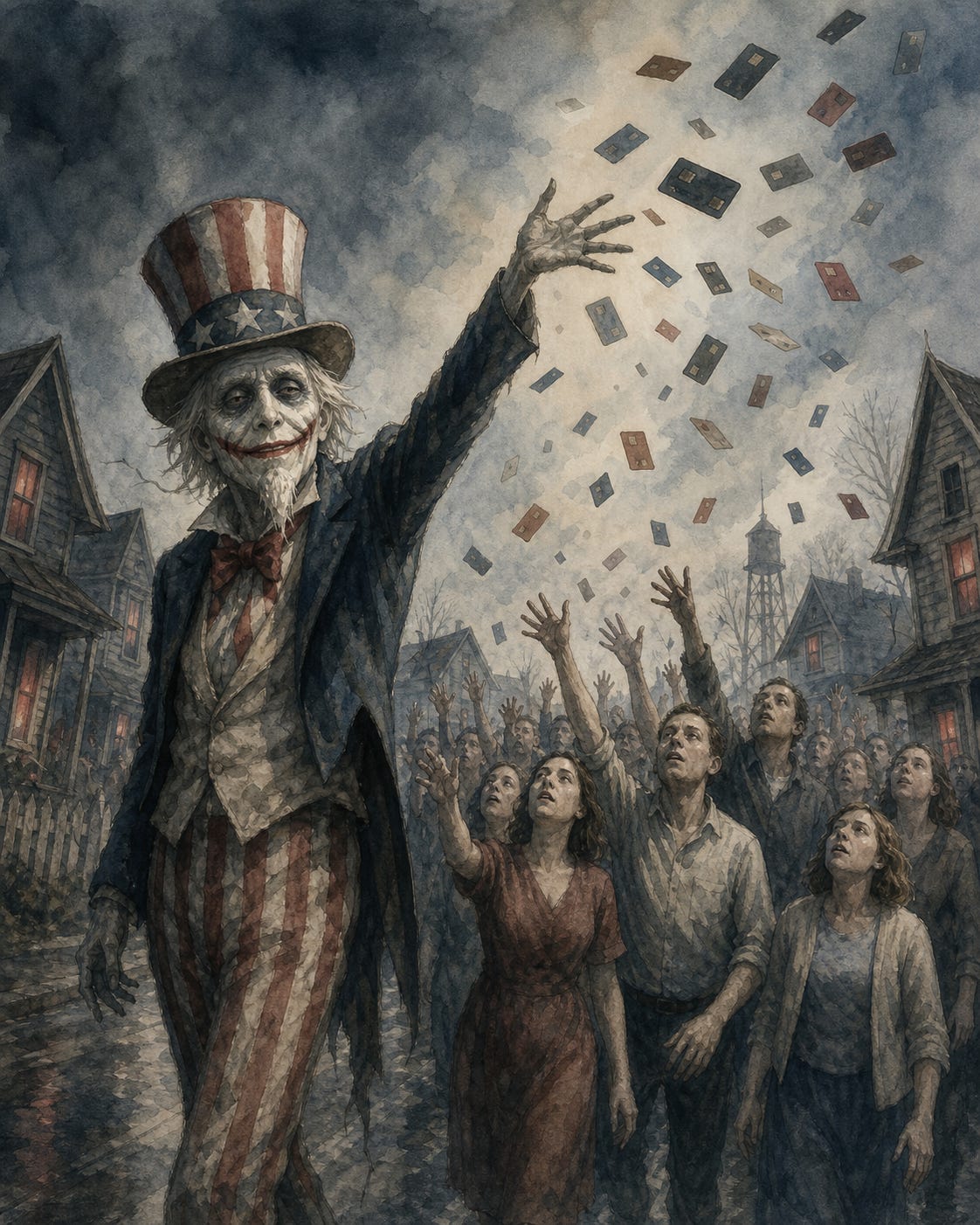
The Credit-Card Republic: Additional insights into how we enabled Nastyland
This is terrain I have walked before. Some of the phrasing and presentation are new, but I have addressed these matters in earlier essays. When your nation has become a horror flick, redundancy is not a flaw. It is required.
The Credit-Card Republic
The nature of American ruling power is not merely to compete within the economy. It is to combine as corporations, financiers, law firms, political organizations, media owners, and wealthy donors and devise durable arrangements that transfer wealth upward while making the public dependent, divided, governable, and unsuspecting.
I do not describe a fantasy meeting in a hidden basement. Instead, I discuss the normal behavior of organized power in a society that provides wealth the means to buy research, lawyers, elections, legislation, judges, advertising, and the language through which people interpret their own lives.
It is a mistake to imagine that this is not deliberate—that the wealthy and the institutions they own are incapable of long-range planning, even as military establishments plan wars decades ahead and corporations plan markets years in advance. Your ruling elite is that malicious, and it is that capable.
The question is not whether elites can plan. They can. The question is whether they have ever been candid enough to say so.
The Powell Memorandum
In 1971, Lewis Powell—a corporate lawyer who would be nominated to the Supreme Court less than two months later—wrote a confidential memorandum to the U.S. Chamber of Commerce titled “Attack on American Free Enterprise System.” Its message was unmistakable: business had to organize itself as a political force and move systematically into the institutions that create public belief and enforce public law.
Powell urged a campaign directed at universities, textbooks, the media, politics, and the courts. He argued that the judiciary was especially important because it could become an instrument for social, economic, and political change. He called for “careful long-range planning,” “consistency of action” over an indefinite period, large-scale joint financing, and the political power available through united national organizations.
This was not an accidental evolution of ideas. It was a strategic instruction manual for corporate America: stop treating public institutions as neutral terrain and begin capturing them.
The ensuing half-century looks very much like its fulfillment. Corporate money flooded politics. Think tanks and legal foundations generated a permanent pro-corporate intellectual apparatus. Media ownership concentrated. Courts elevated property, contract, and corporate political rights. Regulation was recast as oppression, while the actual oppression of debt, rent, monopoly pricing, and insecure work was sold as freedom.
Debt Replacing Wages
The credit card belongs in that history.
When wages cease to rise with productivity, workers cannot continue to buy housing, medical care, education, transport, food, and consumer goods simply by working harder. There are two broad choices: raise wages and provide more public goods, or lend people money at interest so they can buy what their wages no longer cover.
America chose the second.
The credit card makes the choice appear voluntary. A worker uses a card to repair the car needed to reach work, pay an emergency medical bill, buy groceries before payday, or cover rent during a shortfall. But the larger system has already narrowed the worker’s options. Wages lag, public provision is inadequate, and essential costs are privately priced. The card then arrives as a rescue—but it is a rescue that converts necessity into a claim on future labor.
The worker receives temporary purchasing power. The bank receives an ongoing right to a portion of the worker’s future income.
Deregulating Usury
The system did not scale itself by accident. In 1978, the Supreme Court’s decision in Marquette National Bank v. First of Omaha Service Corp. allowed nationally chartered banks to charge the interest rates permitted in their home state rather than the borrower’s state. Banks could therefore locate card operations in permissive states and export high interest rates across the country, hollowing out state usury protections.
The result was a national market in revolving, high-interest consumer debt. A practice once restrained by local interest-rate limits became a major financial industry. It was not an obscure side effect: lenders could plainly see that this legal change would make household indebtedness vastly more profitable.
By late 2025, aggregate U.S. credit-card balances had reached $1.2 trillion—an all-time high. This is not simply evidence of individual irresponsibility. It is evidence of an economy that increasingly requires households to borrow merely to maintain ordinary life.
Education as Debt
The same architecture was applied to education.
A democratic society that genuinely needed an educated population would make education broadly available as a public good: a way to develop human capacities, train citizens, advance science, and permit people to choose their work freely. Instead, America increasingly made higher education an expensive toll gate between young people and the jobs said to be necessary for a decent life.
The message was contradictory but effective:
You must obtain credentials to survive in the modern economy.
You must personally borrow enormous sums to obtain them.
You will then spend much of your working life repaying the debt.
If you fail, the failure will be called yours.
Student debt thus functions not merely as financing for education, but as a discipline system. It narrows the range of work a graduate can take, postpones family formation and homeownership, deters risk, weakens the capacity to organize or strike, and directs people toward whatever employment can service the loan. An education that ought to enlarge freedom becomes an instrument that limits it.
The point is not that learning has no value. It is that the ruling system transformed the desire to learn—and the labor market’s demand for credentials—into a permanent revenue stream for lenders, universities, servicing companies, and the larger financial order.
The Volunteer Army
The volunteer military fits the same political economy.
After the end of conscription, military service could be marketed as an individual opportunity: training, health care, a regular paycheck, housing, and especially help with college. For many young people without family wealth, affordable higher education, secure local work, or health coverage, enlistment becomes less a free calling than one of the few viable routes out of economic precarity.
That is not an accusation against the people who serve. It is an indictment of a society that permits the economic vulnerability of its young to become a recruiting instrument.
The system has made education unaffordable, employment insecure, housing costly, and medical care conditional. It then offers military enlistment as a path to benefits that should have been guaranteed to every citizen without requiring service in a war machine. The country does not need to reinstate a draft if debt and deprivation can perform the same sorting function.
In that sense, the volunteer military is not wholly separate from the credit-card regime or the student-loan regime. All three convert insecurity into obedience:
Credit cards bind workers to employers and lenders.
Student debt binds educated workers to the salary necessary for repayment.
Military benefits bind economically vulnerable young people to the state’s armed apparatus.
Each is presented as voluntary. Each operates inside an economy in which the alternatives have been intentionally narrowed.
Debt as Governance
Credit cards do more than extract interest. They govern behavior.
A person carrying large revolving debt is less free to quit a bad job, strike, relocate, endure a medical interruption, or challenge an abusive employer. Missing a payment can bring penalty rates, collection activity, damaged credit, and reduced access to an apartment, insurance, utilities, or further borrowing. The credit score turns debt payment into a condition of social permission.
That is the deeper achievement of the debt society: it makes the public responsible for absorbing economic shocks that should be borne by employers, public institutions, or the financial system. The costs of illness, unstable work, inflation, inadequate wages, and education are individualized. The return flows upward as interest, fees, securitized claims, and bank profit.
A democratic society would ask: Why are wages inadequate? Why is health care privately rationed? Why is housing unaffordable? Why is education debt-financed? Why must a young person contemplate military service to receive what ought to be ordinary public benefits?
The debt regime changes the questions. It asks only whether the individual debtor has paid on time.
The Designed Outcome
No one needs to prove that Powell himself designed every credit card, student loan, or recruiting campaign to recognize the larger program. The memorandum establishes that corporate power understood its task as institutional: capture the ideas, laws, courts, and political machinery that determine whose interests count.
Credit-card finance, student debt, and the economic recruitment base of the volunteer military became mutually reinforcing instruments within that program. They maintained consumption without raising wages. They made education a private liability rather than a public right. They produced reliable streams of interest and fees. They supplied the armed forces with recruits whose alternatives had been made precarious. They weakened the independence required for citizens to act collectively.
The system calls this freedom because the contracts are formally voluntary.
But formal choice is a thin kind of freedom when one choice is debt, another is insecurity, and a third is military enlistment. The deeper achievement is to make a population sufficiently comfortable to remain compliant, sufficiently indebted to remain afraid, sufficiently credentialed to serve the system, and sufficiently isolated to believe that the trap is personal failure rather than public design.

Quite a sad story