The last Super Bowl
It did not matter anymore. There was no one left to bamboozle

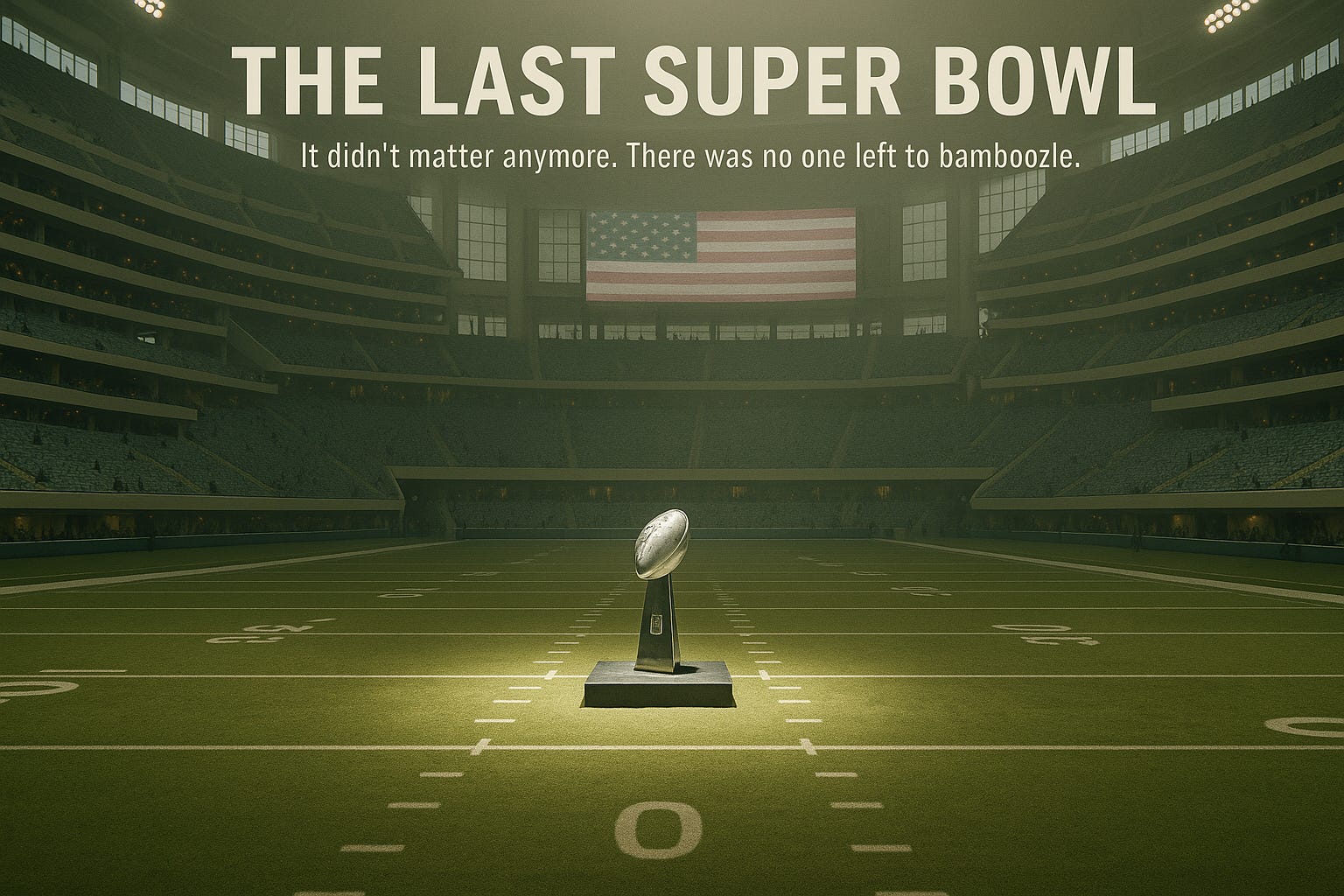
The stadium had never been brighter, and the country had never been dimmer.
On paper, it was the greatest show on earth: Super Bowl LX, a gleaming dome seamed with corporate light, drones writing slogans across the winter sky, an ocean of screens blinking in unison like a single, stunned eye. The commentators called it “America’s night,” though no one could say exactly what America was anymore, except a logo that kept losing resolution every year.
Tickets cost more than most people’s cars. The pre‑game show began at breakfast and never ended, a continuous river of noise pouring through phones and living rooms. An army of entertainers had been flown in to reassure the public that everything was still fine, still normal, still number one. Fireworks were stacked on the roof. A halftime stage the size of a small city waited just outside the tunnel, pre‑assembled and choreographed down to the millisecond.
It looked, from a distance, like a civilization confident in itself.
Up close, it looked like a nervous breakdown with better lighting.
I. The Last Ritual
They called it “the last Super Bowl” only in private, at first. Not because there wouldn’t be another game, or another league, or another excuse to sell beer and insurance, but because even the executives could feel that the spell had slipped. Spectacle requires belief. This year, belief was short.
Outside the stadium, the dollar had begun to die in ways you couldn’t hide with a graphic. Prices moved like frightened animals. Foreign central banks quietly stacked gold while smiling politely on camera. New clearing systems and currencies had appeared like islands at low tide, and capital—real capital, the quiet kind—had already started moving to them.
Inside the stadium, the ads were still priced as if none of that were happening. Thirty seconds of airtime could buy you a small factory somewhere that actually made something. They spent it instead on jokes about snack food and mock‑heroic car chases, selling a kind of normality that no longer existed outside the frame.
The game itself didn’t matter. It hadn’t mattered for years. What mattered was that the audience believed it mattered, that they stayed in their seats long enough to be bathed in commercial light. But something had changed. People watched, and they did not forget themselves. They saw the scaffolding. They saw the price tags.
They had been through too much.
II. The Halftime Catastrophe of Meaning
For decades, the halftime show had been the empire’s annual self‑portrait. It had started as marching bands and baton twirlers and had ended as a rotating pantheon of exhausted pop gods, each one compelled to prove in twelve minutes that America still had culture by stacking louder, brighter gestures on top of a hollow core.
This year’s show was the most expensive ever staged. The producers said so proudly. It was, they promised, “a celebration of who we are.”
Who we were, it turned out, was a fog machine strapped to a credit derivative.
The performer—one of those famous for being famous, whose name had been a brand before it was a person—rose out of the stage on a platform of LED screens. Behind her, holograms of earlier halftime legends shimmered, as if the culture itself were trying to remember when it had last meant anything.
She shouted the ritual phrases. The crowd shouted back, but there was a noticeable lag, as if the call‑and‑response had been routed through some distant, failing server. Cameras swooped, fireworks detonated on cue, dancers moved in perfect unison, and yet the whole thing landed with the soft, dull thud of an overinflated ball.
It wasn’t that the show was worse than previous years. Technically, it was better—tighter, more advanced, louder, brighter. That was the problem. It was the apex of a form that no longer connected to anything living. The more it insisted on importance, the more it revealed its irrelevance.
In living rooms across what remained of the country, people watched and felt nothing. They were tired. Their rent was late. Their retirement accounts had been quietly harvested by inflation and currency games they were never invited to understand. Their sons and daughters were picking up gigs in other languages, other currencies, other time zones.
The halftime show promised them transcendence. The most it delivered was distraction. And even that wasn’t working like it used to.
III. No One Left to Bamboozle
The real problem was not that America lied. The empire had always run on a certain amount of narrative management. The problem was that the lies had become too stupid for the conditions.
For a long time, the country could afford them. The dollar’s status as the world’s reserve currency was a bottomless bar tab. The rest of the planet extended us credit in the form of oil, goods, and labor. We repaid it in IOUs denominated in a unit we controlled. We bombed the recalcitrant and sanctioned the disobedient, all in the name of “rules” we wrote ourselves.
The trick only worked as long as everyone believed the IOUs would always clear.
By the year of the last Super Bowl, the rest of the world had stopped believing. Quietly at first, then more openly. Bilateral trade deals bloomed that never touched a dollar. New regional currencies emerged with gold or commodities behind them, crude modern bancors designed not for perfection but for escape. Central banks published careful research about “diversification” away from U.S. assets, as if they were discussing diet rather than survival.
Inside America, the news still spoke of “strong fundamentals” and “temporary volatility,” but the language had lost its anesthetic effect. People had watched their savings tanks leak dry too many times. They had seen the pandemic lies, the war lies, the financial lies, the “transitory” lies. They had watched the government fling weapons into conflicts it could not win, while the actual ability to produce things—engines, chips, medicines—atrophied.
The old trick of changing the subject with football and fireworks was wearing thin.
There is a moment in every con when the mark realizes there is no prize at the bottom of the shell. After that, the patter only deepens the insult.
That was the mood of the last Super Bowl. The country had not yet collapsed. The lights were still on. But the shared hallucination that this spectacle meant something, that it testified to a greatness which would continue indefinitely, had dissolved.
They could still beam the images. They could not make anyone believe.
IV. The Athletes and the Empire
On the field, twenty‑two young men collided like planets in pads, doing their jobs as well as anyone had ever done them. They were not the villains here. They were professionals in a dying circus, running plays for a currency whose value no one could explain without looking at a chart of foreign reserves and gold flows.
They had grown up being told this was the pinnacle: the ring, the parade, the endorsement deals. And for them, individually, it still mattered. The human need for excellence is real, even when the arena is absurd.
But the old metaphor—the team as nation, the game as war, the victory as proof of destiny—had curdled. It was hard to get too worked up about a touchdown when the scoreboard of empire had gone into permanent glitch.
They played anyway. People always do, even at the end. Rome still built amphitheaters after it lost legions. Bread and circuses are not a strategy; they are a reflex. The real difference now was on the other side of the cameras. The overseas audience had shrunk. Fewer foreign networks even bothered to carry the game live. The myth of American invincibility had been replaced by something closer to wary amusement. The Super Bowl, once sold as a global event, was drifting back toward what it had always secretly been: a provincial pageant with expensive costumes.
V. After the Lights
You could not tell, from the broadcast alone, that it was the last Super Bowl that mattered. The logo looked the same. The confetti cannons worked. The MVP choked up on cue. A tired pop star dragged herself back out for one more reprise, framed by fireworks and brand names.
But something subtle had gone missing.
There was no longer a sense that this was the center of anything.
The ads felt like the desperate clearing of inventory before a store closing. The halftime show felt like a nostalgia act for a culture that no longer existed. The flag‑draped fighter jet flyover—one of them kept out of the boneyard just long enough for this chore—felt less like pride and more like a reminder of how much had been squandered on machines that could no longer guarantee victory.
In the weeks that followed, markets kept moving, as they always do. The dollar suffered another shock. A major country announced that, from that day forward, its oil exports would be priced in a new unit partially linked to gold. The United States issued statements, then warnings, then sanctions. The world yawned and re‑routed.
Analysts who had once been careful began to say in public what they’d only whispered before: that it was increasingly rational for large pools of capital to avoid long‑term exposure to U.S. assets, that the old “safe haven” story was breaking, that the game had changed. They didn’t call it treason. They called it fiduciary duty.
At home, people kept working, or trying to. The games continued. The league scheduled Super Bowl LXI, and then LXII. But each year, the event felt a little more like a reenactment in a theme park. The advertisers, the foreign audiences, the young talent with options elsewhere—all began to drift.
What made the last Super Bowl the last was not that it was the final contest played under that name. It was that, by the time the confetti fell, there was no one left to bamboozle in the way that counted.
The rest of the world had moved on, building other circuits of value, other rituals with different currencies at their core. And inside the country, the people who still bothered to watch did so with a new, sullen clarity. They could see the strings. They knew the empire’s muscles had withered under the costume.
The lights went out in the stadium that night on schedule, one bank at a time, clicking into darkness like a row of switches in an old electrical panel. Crews swept the stands for trash. Workers tore down the stage. Trucks rolled out, heavy with the physical remnants of the greatest show on earth.
The next morning, the sun came up on a nation that still had its nukes, its drones, its lawyers, and its logos. It had its last illusions too, but they were fraying. The world had seen the halftime act for what it was: not culture, but compensation; not triumph, but noise.
In the end, the last Super Bowl did what it had been designed to do. It reflected the country back to itself.
The problem was that, by then, the country finally recognized what it was seeing.
Got here through MoA, thanks! Fantastic piece and analysis. It is not just breads and circuses. The shiny potemkin village with neon lights hides the truth, and everyone feels it.
Mainstream doesn't educate or enlighten the public, they are collaborators, or rather, traitors. Withholding the truth on purpose is lying. Who knows about the new payment structures like CIPS, with real time payments instead of the West's outdated SWIFT, five days?!
It would take seconds to enlighten Americans and Europeans, yet the Empire's increasingly deranged lies rage on. Instead of explaining the 2014 Maidan CIA/NED/CFR coup, Dutch fashion magazines had "FUCK PUTIN" sweaters in 2023.
Where does that originate? A Parisian runway sweater, for a Spring collection, is designed and produced a year before. And who printed and organized the Ukrainian flags and stickers when the SMO started? How easy is it to state the truth: International Law allows for regional referendums, besides, Kiev/NATO killed 14k civilians, in the 90% Russian speaking oblasts.
Shortly before Ukraine, actually in 2021, I wrote: mmm...Plandemic panic is dying down, I wonder what they will cook up next, war, famine or climate lockdowns? War it was, since there's even more money to be made then the environmental schemes. And that neocon, MacKinder based plan had been in the making for decades.
The Epstein revelations ought to focus on the depravities, however that is a red herring. It is the globalist, conspiratorial nature of Epstein, Summers, WH, YGL, BIS, cryptocoins that must be addressed. And it will not. The structures are all in place, and threats to the system are not allowed to be (s)elected. Money and global businesses dictate the system, politicians follow the script, same as the Super Bowl.
The hollowness of the Super Bowl directly reflects the emptiness of our political system. We are the peasants paying taxes and voting (never again, nothing changes). We do not have the money to access politicians. Still, I see slivers of sanity, from other freethinkers and analysts, Sonar21 and MoA commenters. And hopefully more people will free themselves.
Like I joke in comedy; 1984 wasn't supposed to an instruction manual. Thanks for your wonderful article, J.
The gladiators in the coliseum continue the pageant.
Let the games begin.
Ppl are reminded that Puerto Rico 🇵🇷 is part of US. Grocery clerk will be the star of the show.
This analogy exposes the cracks in the spectacle. 🇺🇸