
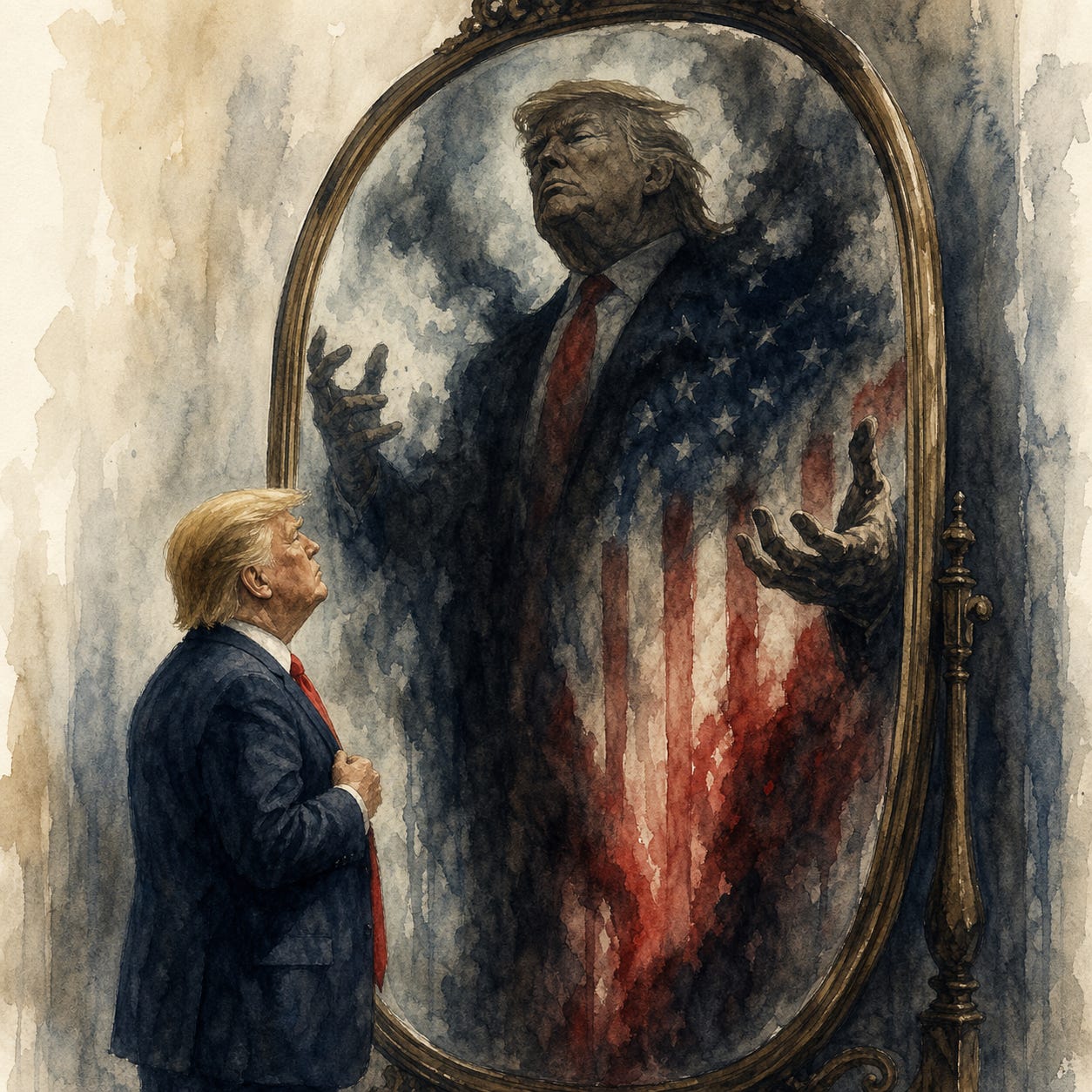
The Mirror and the Monster: On Trump and the American Id
Everywhere you see people stating and explaining, with moralizing woe, that they are shocked by Donald Trump.
Yes, there is no question about it, Trump is a piece of work.
Probably the most frightening thing about him is that he says directly what almost every president since Kennedy has thought, or come close to thinking, but has been too astute, afraid, or circumspect to say. He doesn’t translate power into noble prose—he just speaks it raw. And that, I think, is why he bothers people more than any policy or scandal ever could.
The question for all Americans should be: Are we seeing ourselves, or at least our actions, in Trump? Does he bother us because we are gazing into the mirror at our monster Id?
In college I had what was once called a double major, a lot of economics, a lot of psychology, with some sociology stirred in, combined with a lot of autodidact analysis of American history. This is where my thoughts originate, that and a novelist’s eye and observing America for over seven decades.
I’ve been thinking for a while that this Id conundrum is the real reason Trump so unsettles people.
It is not about left or right. It is about the collapse of a national performance we have all been invested in maintaining.
In dramaturgical terms, Trump broke the barrier between the front stage and the backstage.
Every president before him performed the idealized national self—the shining city, the liberator, the reluctant warrior forced into action by circumstance.
Meanwhile, the backstage was always there: the coups, the drone strikes, the CIA overthrows, the systemic injustices codified into law and policing. We knew it, but we didn’t have to look at it directly because the performance of virtue gave us cover.
Then Trump arrived and he refused to perform the normal presidential role.
Instead he stripped away the performance piety pretty, and simply owned the action, stripped of moral pretension.
He too had watched America; he knew what we were about, so why lie about it, state the obvious. And in doing so, he forced us into the land of cognitive dissonance.
When a nation holds an identity as “the good guys” but commits actions that contradict that story, we usually resolve the tension by compartmentalizing or reframing.
Trump does neither. He simply says “America First,” “take the oil,” “they’re poisoning our blood”—and then he asks us to join him in the obvious. To justify ourselves.
That labor, that mental weight, is exhausting. And we resent him for making us straighten the face and carry it.
But here is the deeper cut: We are horrified because we are looking at ourselves.
If we are defined by our nation and what it does and its actions, then we have always been the monster who hid behind the costume.
Previous presidents acted out the national Id but spoke in the language of the Superego, so we could cheer the action while feeling virtuous about the words.
Trump reversed this: he spoke the language of the Id, while actually doing less imperial overreach than some of his predecessors.
This exposes a terrible truth. If we are horrified by Trump’s words but were not by Obama’s or Bush’s or Clinton’s drone campaigns, then our morality was always attached to aesthetic packaging, not to actual deeds.
We were comfortable with the actions so long as they were wrapped in borrowed conscience.
And so we have a sociological rupture of the national mythos.
What Trump offends is not liberal or conservative sensibilities—it is the human need for narrative coherence, the story that “we are good, our actions are justified, our history is progress.”
Trump says: We are powerful, and that is enough. He doesn’t introduce the monster; he just stops translating it into diplomatic prose. And our rage is the Superego’s last defense: Don’t make me look at what I’ve been complicit in.
So the mirror holds. Trump is not the monster under the bed. He is the monster in the bed, and we cannot unsee that we invited him there. The real question now is not whether Trump is the Id. The question is: Now that you have seen the reflection clearly, will we change our actions—or just demand prettier words for the same deeds? Because if we choose the latter, then we are, all of us, the Id, dressed in a borrowed conscience, and that is far more frightening than any one man.
That is what I have been seeing for years.
Trump made the idea obvious.
Trump bothers us because he forces us into authenticity—into the uncomfortable position of either accepting that we support an amoral nation or actively resisting it.
Both are harder than the old comfortable lie. And that discomfort, that forced confrontation with the mirror, is the real reason the country cannot look away.
Uncomfortably numb