The Nightmare Cometh
The Drums of Moria: America at the Edge

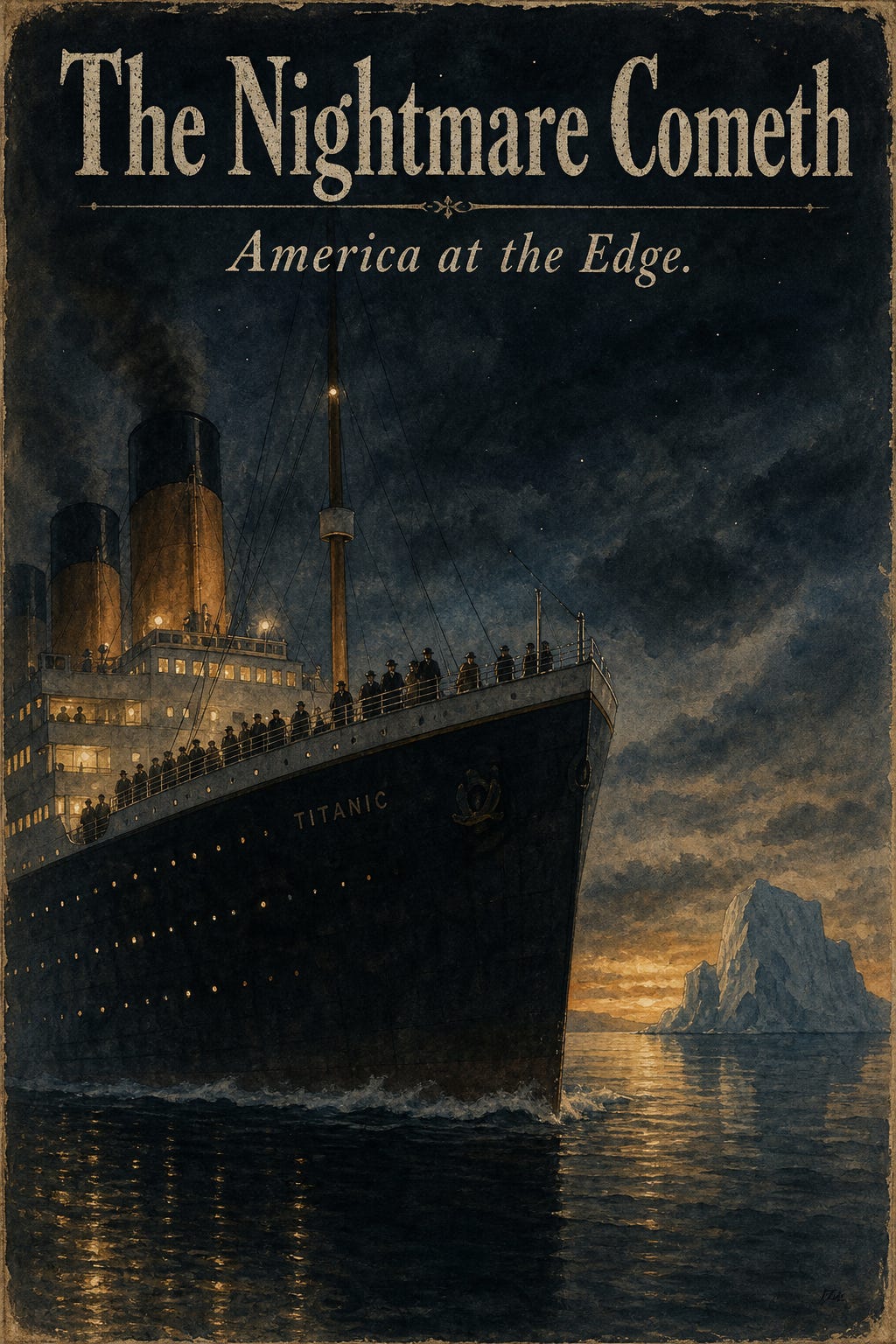
The Nightmare Cometh
The Drums of Moria: America at the Edge
Over the last few years I have written more than one essay about each of these issues. So, much of what follows is less detailed than what I have previously said and written — but this morning, at the end of May 2026, as I wait for the sun to rise and pinken the western sky,
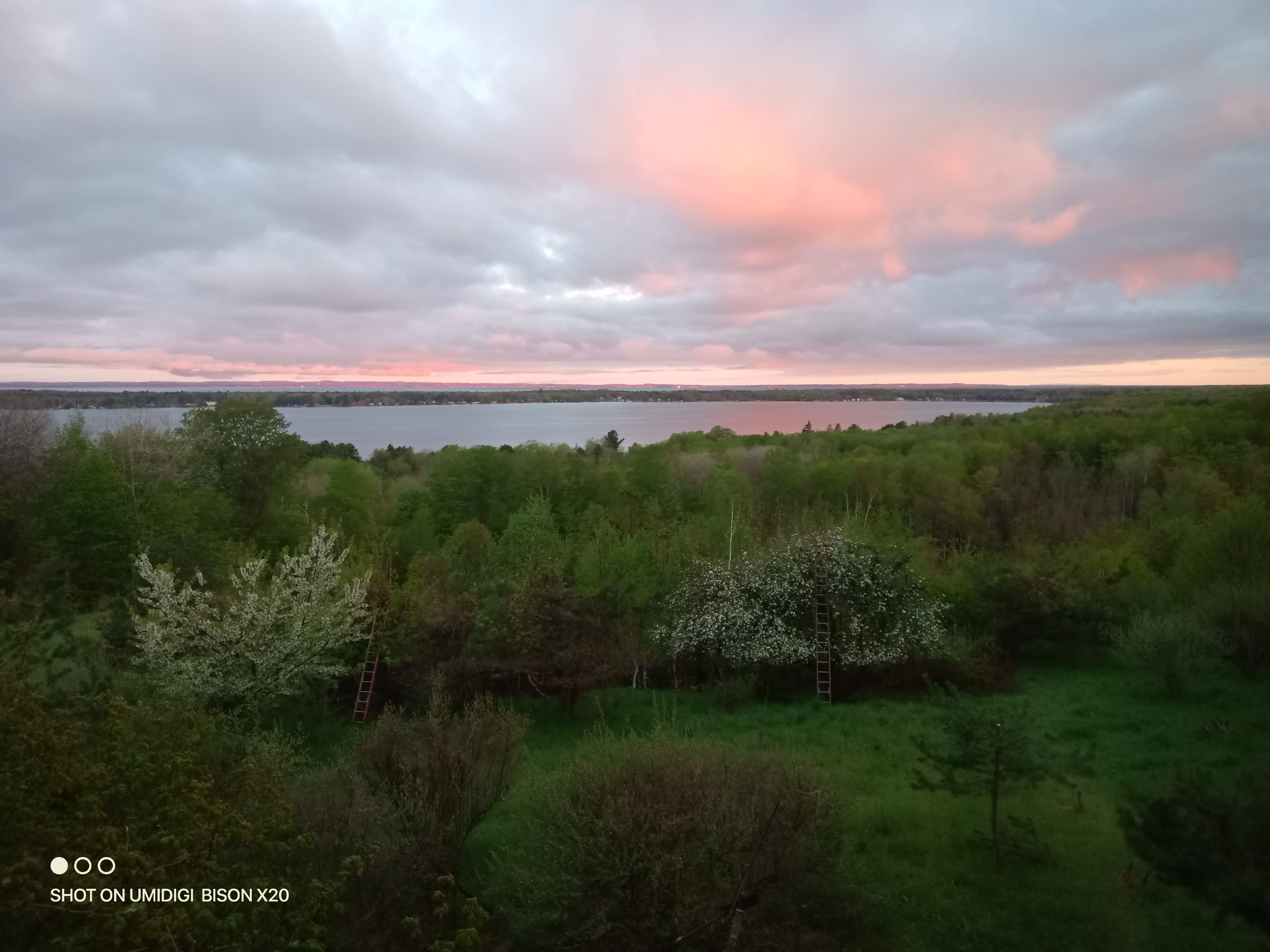
these are the thoughts that surround me as I dictate into that curious little ubiquitous gadget called a smartphone.
There is a particular kind of tragedy that edges into farce — not because the suffering is unreal, but because the architects of catastrophe proceed with such cheerful, willful blindness that an observer could almost laugh if the stakes weren’t so final. We are living inside that tragedy now. And the curtain is coming down.
The Wars We Pretend Are Victories
Let us begin with the blood, because that is where honesty demands we begin. For over two years, the United States government — under both parties, though with different degrees of enthusiasm — effectively applauded a genocide in Gaza, furnishing the weapons, the diplomatic cover, and the institutional silence that made it possible. Those who spoke out were not debated; they were shouted down, smeared, and career-destroyed. Criticism of Israeli state policy was systematically conflated with hatred of Jewish people — a rhetorical trick that served neither truth nor the genuine safety of Jewish communities, but served power extraordinarily well. Free speech, that foundational American pretension, revealed itself to be conditional, available only to those whose dissent costs nothing.
Then came the man who campaigned on peace. The second Trump administration arrived promising an end to foreign adventurism, a return to something called America First. What followed was the opposite: a cascade of military actions, provocations, and what can only be described as the worst strategic military disaster the United States has suffered in living memory — a humiliation so profound that military historians will be writing about it for generations, assuming there are functioning universities left to house them.
But to speak only of policy is to miss the more terrifying truth: the man executing these decisions is not merely misguided. He is, in the most clinical sense of the word, unwell. The grandiosity is not a pose — it is a compulsion. The retribution is not a strategy — it is a psychological need, as reflexive and ungovernable as breathing. He cannot distinguish the nation’s interest from his own ego because, at the level of his psychology, no such distinction exists. The nation is his ego. What flatters him is good policy. What threatens him is treason. This is not the profile of an eccentric executive or even a cynical autocrat playing a long game. This is the profile of a man who belongs in a quiet room with padded walls, not in the Situation Room with nuclear codes. History has seen such men before — and history does not record their endings well, nor the endings of the nations foolish enough to hand them power. He fancies himself Louis XIV, redecorating the capital in gold leaf and imperial grandeur while the republic’s foundations crumble beneath the marble floors. Louis XIV, at least, understood statecraft. What we have is the vanity without the competence — the costuming of empire at the precise moment the empire is running out of road.
The Economy We Hallucinated
For thirty years, America made a decision so catastrophic in its simplicity that future historians — again, assuming they exist — will marvel that no one stopped it. We decided that making things was beneath us. Manufacturing moved to China, to Vietnam, to anywhere labor was cheaper and environmental regulations more accommodating. We would be the idea economy, the service economy, the financial economy. We would think the great thoughts and let others soil their hands.
What replaced manufacturing was not genius. It was leverage. Financial instruments multiplied like viral cells, each feeding on the last, until the “economy” became largely a performance — a theater of valuations, derivatives, and asset-price inflation that registers as wealth on spreadsheets while producing nothing a hungry person can eat or a cold person can wear. The stock market climbed. The middle class did not.
Into this void rushed the data economy, which promised to be the new foundation of American supremacy. We would know everything — every click, every search, every purchase, every whisper — and this omniscience would be monetized into permanent competitive advantage. So we built data centers, vast big-box sprawls, our nation’s new cathedrals — conspicuously lacking architectural beauty or any rose windows. In an economy stripped of manufacturing, drained of shipping volume, and hollowed of genuine industrial output, the data these centers process is largely the record of Americans selling things to each other, watching each other, surveilling each other. The essential global data — the shipping manifests, the manufacturing yields, the agricultural outputs — belongs increasingly to other nations, because they are the ones actually doing those things.
The wealth appearing to rise in the markets sits almost entirely in these mutually reinforcing technological enterprises, each one’s valuation dependent on the others’, a closed loop that generates the appearance of productivity while the physical economy beneath it quietly starves. It is a Ponzi scheme at civilizational scale.
The Land Itself Is Failing
Even if we set aside the wars, the financial fraud, and the collapse of institutional legitimacy — the land is in crisis.
The Ogallala Aquifer, which irrigates the breadbasket of America across eight Great Plains states, has been depleting for half a century. Farmers have been drawing from it faster than it recharges — in some areas the recharge rate is measured in inches per century — and it is now approaching zones of depletion that will make vast stretches of current farmland simply unviable. This was already an emergency before the latest round of low snowpack winters. Now it is an accelerating catastrophe, because diminished mountain snowpack means rivers run lower in summer, which means agricultural demand on groundwater increases precisely as the reserves thin.
Lake Mead, the reservoir that defines the water supply for tens of millions in the Southwest, is projected to reach historic lows by midsummer. The Hoover Dam is already throttling back power generation. Phoenix, Las Vegas, Los Angeles — cities built on the audacious premise that the desert could be indefinitely irrigated — face a reckoning that no amount of political denial can postpone much longer.
Global warming, whatever the current administration’s position on its existence, continues without regard for policy preferences. The jet stream destabilizes. Weather grows more extreme and less predictable. Agricultural seasons shift. The insurance industry — which unlike politicians must actually price risk — is quietly withdrawing from coastal and fire-prone markets, which is perhaps the most honest signal available about where the physical future is headed.
The Convergence
What makes this moment historically singular — and what gives it a weight the Great Depression and even the Dust Bowl did not quite carry — is the convergence. The 1930s were terrible. But the land was not yet aquifer-depleted, the climate was not yet structurally destabilized, the manufacturing base had not yet been exported, and the United States was not yet an empire on the declining arc. Most critically, in the 1930s there remained a coherent institutional apparatus — battered, corrupted, but present — capable of a New Deal, capable of mobilizing, capable of reform.
What institutions remain today that could execute something equivalent? Congress has become a performative body. The regulatory agencies have been systematically dismantled or captured. The judiciary has been reshaped as a political instrument. The military has just suffered a catastrophe that will take years to process. The dollar’s reserve status, long the backstop of American financial power, faces coordinated challenge from trading blocs that have grown tired of subsidizing American consumption.
The empire is in its terminal chapter. Empires do not always end in dramatic collapse — sometimes they simply become less relevant, slower, poorer, less capable of projecting force or demanding deference. But when an empire’s decline coincides with environmental crisis, financial fraud at systemic scale, and leadership that responds to emergency with vanity and belligerence, the decline accelerates beyond anything historical precedent would suggest.
The Ship and the Ice
We are on the Titanic. The comparison is almost too gentle, because the Titanic was at least a beautiful ship, and at least the iceberg was an accident. What we face is the result of choices — long chains of choices made by people who knew better, advised by experts who were ignored, warned by data that was dismissed. The orchestra plays. The champagne flows. The first-class passengers remain confident that ships of this size simply do not sink.
They do. They sink quickly. And when the water reaches the lower decks, the distance between the panic of the privileged and the resignation of those already underwater turns out to be very small.
Even peace tomorrow — sudden, miraculous, complete — would leave us a minimum of six months from anything resembling stability, and by then the cascading economic effects, the supply-chain ruptures, the debt obligations, and the geopolitical realignments already in motion would be feeding a global economic contraction that makes 2008 look like a quarterly dip. Famine is not a melodramatic projection; it is the arithmetic result of disrupted agricultural trade, depleted aquifers, climate-stressed growing regions, and supply chains already fractured by years of trade war and military conflict.
There is no clean way to end an essay like this, because the situation does not offer a clean ending. What remains — what has always remained in the darkest passages of history — is the obligation to see clearly, to say what is true, and to refuse the comfortable fictions that keep the music playing while the ship goes down. That, at minimum, is what the moment demands.
Coda: The Document That Doomed Us
Yes, we are in a frightful mess. It is one we have made for ourselves — we, because of our nature and our system, are responsible for this nightmare. And if we are honest, we must trace the rot to its root.
I have become convinced that the only way to save the country is to dump the Constitution and adopt a new one.
Jefferson’s Declaration of Independence was the first bamboozle. He took John Locke’s foundational trinity — life, liberty, and property — and swapped in happiness. It sounds generous, even beautiful. It was neither. He meant property: slaves, land, and elite wealth. Happiness was the fooler, the pretty word that made the document sing while the machinery of exclusion hummed beneath it. We have been humming along to that tune for two and a half centuries.
We took a document designed to keep the common man from having a say, and we nobelized it. We made it a wonder of the world, a sacred text, practically scripture — when in reality it was a mechanism engineered by rich white slaveholders in a locked room in Philadelphia to hold onto their property and ensure that whatever came next, the out of doors, as they called the common people, would never get ahead. The Bill of Rights was an afterthought. Crumbs tossed to the crowd to prevent another uprising.
Remember what actually triggered the Constitutional Convention: Shays’ Rebellion. Farmers — veterans of the Revolutionary War, men who had bled for the promise of freedom — rose up against the banks and creditors stealing their farms and livelihoods. The response of the ruling class was not reform. It was consolidation. A group of wealthy men locked themselves in a room, stole some pretty words from the Enlightenment, and fashioned a system where the people who had just won a revolution could never again threaten the people who owned everything.
As Robert Ovetz argues in We the Elites, and as Charles Beard argued before him in An Economic Interpretation of the Constitution of the United States (1913), the Constitution was designed not to facilitate meaningful systemic change but to prevent anything that does not serve the interests of the propertied class — and it has performed that function with remarkable consistency ever since.
This document is why we are a mess. It is the chassis on which every subsequent failure has been built. You cannot fix the car by changing the tires. You must melt it down and start again.
What might we build? There is a framework worth examining — Phoenix America — which begins not with anger but with a more radical premise: that human beings, given a genuine chance, will choose to create, to contribute, to connect, to become. It posits that for the first time in history we have the technological capacity — the robots, the machines, the abundance — to lift the boot of scarcity permanently from the neck of the common person. The only things standing between every American and a life of genuine creative purpose are the document written by slaveholders, the Congress that serves billionaires, and the financial system designed to keep the many poor and the few obscenely rich.
We are not talking about destroying America. We are talking about finally building it — the version that was always promised and always denied. The phoenix does not mourn the ash. It rises from it. Whether we have the collective courage and clarity to light that fire, before the ship finishes sinking, is the only question that remains.
We need a new system. We need a new constitution.
Please examine Phoenix America — it may be the most important thing you read this year.
That is not optimism.
Rather, digger out of the hole 🕳️
You're far more optimistic than I am. People for the most part never change until forced to by disaster. The USA will have to crash and burn before anyone will ever get serious about considering actually implementing an alternative system.