The Unit
De-dollarization accelerates: Additional reasons to purchase gold - and how the Unit works

Additional reasons to purchase gold and how the Unit works
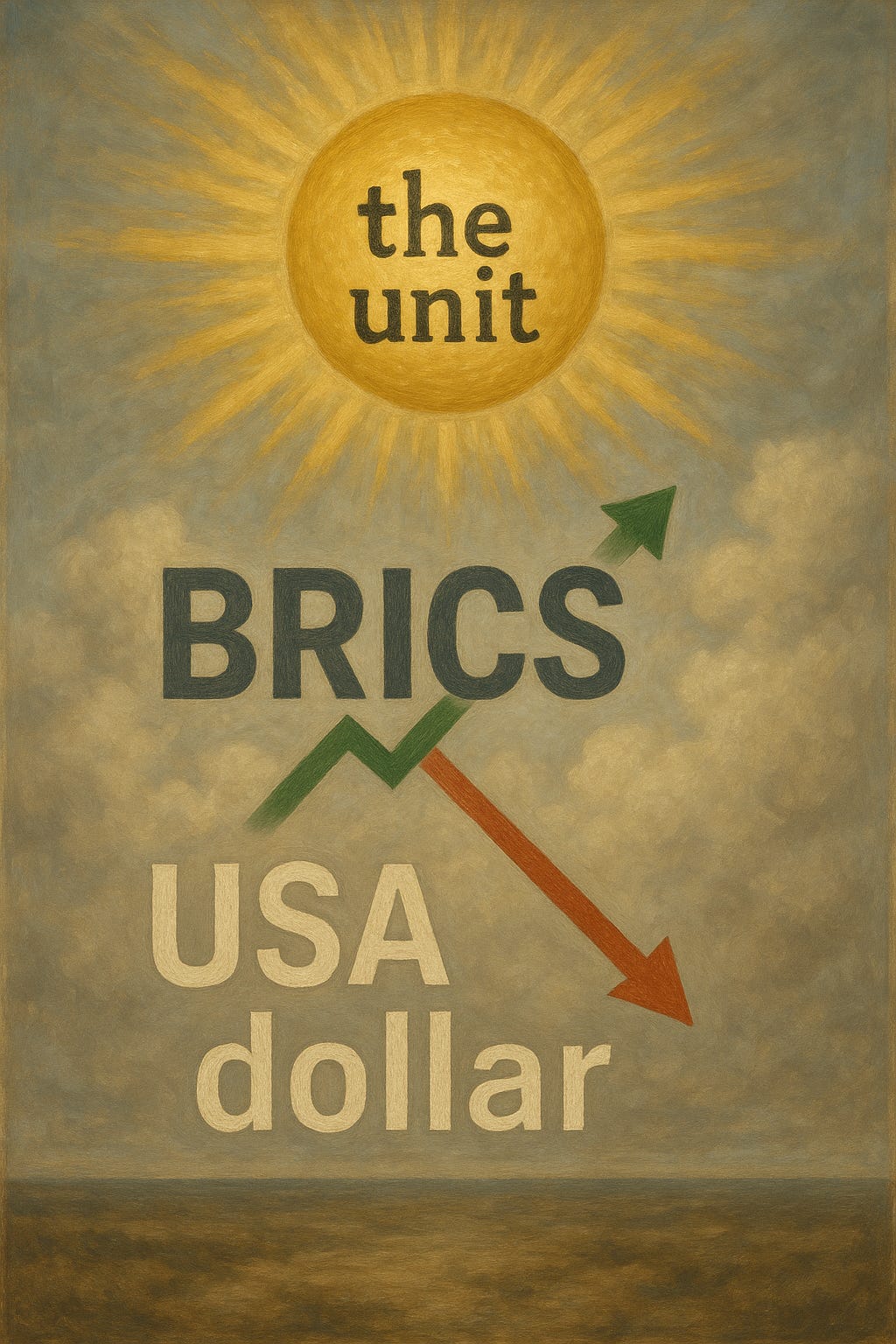
The Unit: BRICS Builds a Monetary Lifeboat While the Dollar Sinks
Pepe Escobar’s recent article on Sputnik unveils something remarkable: a fully developed alternative to dollar hegemony that isn’t just theoretical posturing but actual financial architecture scheduled to launch on the Cardano blockchain early next year. The Unit—neither cryptocurrency nor conventional stablecoin—represents a benchmark token backed 60% by gold and 40% by diversified BRICS+ national currencies. While Trump hawks his family’s stablecoin empire from the Oval Office, Russian economist Sergey Glazyev and his colleagues have quietly assembled what JP Morgan admits is “perhaps the most thoroughly fleshed-out of de-dollarization proposals that exist in the cross-border transactions space for BRICS+.”
The contrast between these two monetary visions reveals everything about where power is shifting. Trump signed the GENIUS Act in July 2025, requiring US stablecoins to hold 100% reserves in dollars or short-term Treasuries—explicitly designed to “cement the dollar’s status as global reserve currency” by forcing artificial demand for US government debt. His family’s World Liberty Financial venture and USD1 stablecoin have generated over $800 million in the first half of 2025 alone, a sophisticated grift monetizing presidential power while propping up Treasury demand. The Unit, by stark contrast, offers what Escobar calls “apolitical money” anchored in tangible value: physical gold combined with currencies of productive economies running trade surpluses and accumulating reserves.
Glazyev’s Vision: Monetary Sovereignty for the Global South
Sergey Glazyev, Member of the Eurasian Economic Commission Board and architect of Russia’s de-dollarization strategy, co-authored Regulations of the Noonomy with economist Sergey Bodrunov, establishing theoretical ground for the Unit. Glazyev emphasizes the necessity to “ensure a full-fledged switch to national currencies in mutual trade and investment within the EAEU and the CIS, and further – within the BRICS and SCO, the withdrawal of joint development institutions from the dollar zone.” This isn’t idle speculation. By late 2022, settlements in national currencies within the Eurasian Economic Union reached 83%; Russian-Chinese trade achieved roughly 50% substitution of Western currencies with ruble and yuan; EAEU internal trade runs nearly 100% in rubles.
The Noonomy framework—derived from Greek “noos” (mind/knowledge)—envisions a post-economic society where technological progress introduces rational management into what Bodrunov identifies as the chaos and moral decay of neoliberal fundamentalism. This theoretical architecture supports Glazyev’s practical prescription: building financial infrastructure independent of Western speculative capital to enable productive, sustainable development across the Global South. The Unit embodies this philosophy by removing direct dependency on other nations’ currencies while providing non-censored monetary infrastructure that cannot be frozen, seized, or weaponized by Washington.
Superior Architecture: Gold and Productive Economies
The Unit’s 60% gold backing creates structural demand for physical metal that should accelerate the price appreciation already underway. BRICS nations hold approximately 20% of global official gold reserves, with Russia at 2,335 metric tons and China at 2,279 metric tons. In 2023 alone, China added 225 metric tons in its biggest single-year purchase in nearly fifty years. Central banks purchased record amounts of gold in 2024, led by China, Turkey, India, and Russia—a structural rather than cyclical demand pattern driven by geopolitical considerations. If the Unit gains traction, participating nations will need gold reserves proportional to Unit issuance, amplifying this accumulation pattern.
The 40% currency component warrants scrutiny, but these are sovereign fiat currencies of major economies with substantial productive capacity and natural resource bases—not algorithmic tokens or speculative cryptocurrencies. The Chinese yuan, Russian ruble, Indian rupee, and Brazilian real represent economies with significant GDP, manufacturing output, commodity production, and critically, their own gold reserves backing their monetary systems. Glazyev’s design envisions currencies “formed automatically on the basis of the pool of foreign exchange reserves” already held by BRICS central banks. These are state-issued currencies backed by taxation power, productive economies, and central bank reserves—electronic monies functioning like dollar reserves but issued by nations that aren’t teetering on fiscal collapse.
The fiscal contrast tells the story. US federal debt exceeds $36 trillion (over 120% of GDP) and climbing, while Russia’s public debt runs around 20% of GDP and China’s approximately 80%—concentrated in productive infrastructure rather than consumption and endless military expenditures across 800+ overseas bases. BRICS currencies aren’t being printed to finance deficits while maintaining global empire. They’re backing economies with tangible productive capacity, commodity reserves, and manufacturing output, supported by central banks aggressively accumulating gold while Western central banks stagnate or sell.
The Dollar’s Terminal Condition
Trump’s stablecoin apparatus exists to extend dollar dominance through what European officials call “digital dollarization,” forcing more global capital into US Treasury debt to finance a fiscally collapsing empire. The GENIUS Act explicitly requires all stablecoin issuers to “possess the technical capability to seize, freeze, or burn payment stablecoins when legally required”—the precise weaponization that drove BRICS nations toward alternatives. One system attempts to build monetary infrastructure for productive development outside speculative Western finance. The other monetizes presidential power while maintaining the dollar tyranny that has immiserated the Global South for decades.
The Unit launches on Cardano, offering decentralized infrastructure where transactions are permanently secured without third-party mediation, accessible through both centralized and decentralized exchanges. Individuals and companies can acquire Units directly with fiat through regulated banking partners, creating a bridge between traditional finance and emerging decentralized ecosystems. This isn’t theoretical. The software and mathematical tools exist; three BRICS heads of state have expressed support; political will—not technical capacity—is the only remaining barrier.
We’re watching the future take shape. The dollar’s reserve status depends on forcing the world to hold US debt instruments that finance consumption and military empire. The Unit offers neutral, non-sovereign settlement backed by gold and productive economies—precisely what the global monetary system needs as Bretton Woods’ corpse finally collapses. For those holding gold and mining equities, the Unit represents structural demand that should continue driving prices higher as the BRICS+ bloc builds monetary infrastructure beyond Washington’s reach. The coffin lid is closing on dollar hegemony.
My opinion… Buy more gold.
References
Fact Sheet: President Donald J. Trump Signs GENIUS Act into Law
Inside the Trump family’s global crypto cash machine | Reuters
Crypto promoters saw Trump as their savior. Then reality set in | LA Times
Sergey Glazyev speaks about the potential of a single currency of the BRICS countries | TV BRICS
The BRICS De-Dollarization & What It Means for Gold | Nestmann
De-dollarization: What the Shift Means for Gold Investors | Crux Investor
Gold Rally Driven by De-Dollarisation and Debasement Trends 2025 | Discovery Alert
How Would a New BRICS Currency Affect the US Dollar? | Investing News
Back to the future: gold in international reserves as a new stabilizer | SUERF
How will the GENIUS Act work in the US and impact the world? | World Economic Forum
Dollar Dominance in an Age of Stablecoins | Macroeconomic Policy Nexus
How Stablecoins Are Extending U.S. Dollar Dominance | Digital Chamber
A BRICS currency project shows dedollarisation in its making | Tips for Thought